
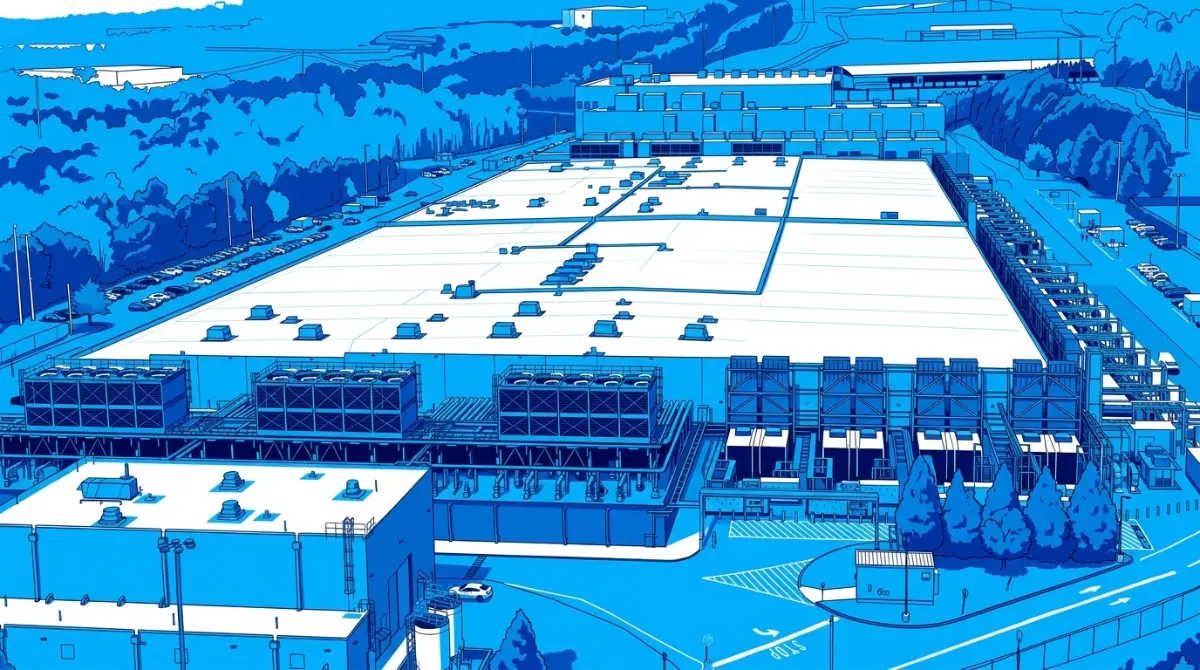


South Africans Demand Pause on New Tech Server Farms
Activists across South Africa are fighting to halt foreign server farm construction, citing severe threats to municipal water supplies and the national electrical grid.
Inioluwa Ademidun | 13 Sept. 2026 · 6 min read

I clearly remember standing in Cape Town several years ago watching residents line up for bottled water. The local reservoir was almost empty. The government had declared an impending Day Zero. Today, the rain has returned, but a different kind of thirst threatens the region. Massive American and Asian technology corporations are arriving in South Africa, bringing plans to construct immense computing facilities. These buildings require millions of gallons of water and enough electricity to power small cities. Local citizens have finally decided they cannot support this level of consumption.
This week, civil rights organizations formally demanded a temporary halt on all new digital infrastructure projects across the nation. The activists want strict environmental assessments before a single piece of heavy machinery moves dirt. They argue that foreign software companies operate in total secrecy, refusing to disclose exactly how much local water and electricity their planned server farms will consume. When you live in a country that spent the last decade suffering through daily rolling blackouts, allowing a multinational corporation to quietly secure hundreds of megawatts of power feels deeply unfair.
The Collision of Global Algorithms and Local Survival
I spent the weekend analyzing the specific demands issued by the activists. The movement is gaining serious momentum. The South African Human Rights Commission stepped into the debate, opening a public consultation period to evaluate the physical impact of these technology sites. The commission received over two hundred and fifty detailed submissions from worried residents. The submissions share a common theme. The public refuses to sacrifice their drinking water simply so users in London and New York can ask artificial intelligence chatbots to write poetry.
The numbers involved are staggering. Recent reports suggest that major Silicon Valley entities have purchased large tracts of land across Johannesburg and Cape Town. In one specific instance, developers secured a massive plot valued at roughly $50M. The planned facility on that site would require approximately 160 megawatts of electricity. To understand the scale, you must realize that the entire South African grid barely handles residential demand during peak winter months. We recently reported that regional telecommunication companies and foreign investors are also rushing to build massive 150-megawatt computing sites across the continent. The cumulative drain on the local power supply is mathematically terrifying.
The activists point out that cooling systems pose an equal threat. Computers generate intense heat. When thousands of processors run simultaneously, operators must pump chilled water through the building to keep the hardware from melting. Some newer facilities boast closed-loop systems that recycle moisture, but the total environmental cost extends further. Generating the electricity required to run the air conditioning also consumes water at the coal plants. The local activists did the math. They realized that every search query processed on these local servers indirectly drains the national water table.
A Resistance Movement Taking Shape
The frustration extends beyond environmental anxiety. It touches on national sovereignty. The South African government actively courts foreign direct investment. Politicians want to brand the nation as the ultimate technological hub of the continent. President Cyril Ramaphosa recently estimated that South Africa currently holds about seventy percent of the total computing capacity on the continent. The politicians see server farms as physical proof of economic progress.
The working-class citizens living near these proposed construction sites see something entirely different. They see wealthy foreign corporations buying up prime real estate while local municipalities struggle to provide basic sanitation. When the national utility company, Eskom, enforces load shedding, ordinary families sit in the dark. Small businesses lose money because their refrigerators stop working. In response, thousands of citizens are independently building their own power security by purchasing off-grid solar equipment. Watching a foreign software giant jump to the front of the line for utility connections breaks the social contract.
The Response from Silicon Valley
I reached out to industry insiders who manage global real estate for these massive technology firms. They argue that local anger is misplaced. They claim that their facilities create jobs and stimulate the regional economy. They also point out that their corporate parents fund renewable energy projects to offset their consumption.
That argument rarely holds up under intense scrutiny. Building a computing facility requires hundreds of construction workers for a year. Once the site goes online, it operates like a fortress. A building the size of three football fields might employ thirty permanent security guards and ten network engineers. The wealth generated by the computers flows directly out of the country to shareholders overseas. The physical burden remains local.
The companies also claim that forcing them to wait for environmental assessments will chase investment away. Pitso Tsibolane, a senior academic focused on information systems at the University of Cape Town, recently dismissed this threat. He noted that serious investors do not fear clear rules. They fear uncertainty. An unregulated boom creates a chaotic environment where community protests can shut down operations overnight. Clear guidelines would actually protect the corporate operators from sudden public backlash.
A Warning for Emerging Economies
Let us consider the global context. The largest software companies on earth are currently locked in a brutal race. They are competing to build the most advanced artificial intelligence models. This race requires raw computing power. As they exhaust the available electricity grids in North America and Europe, they look toward emerging markets for cheap land and compliant local governments. They assume that developing nations will welcome any form of investment without asking difficult questions. The organizers in Cape Town are proving that assumption completely wrong.
The situation also highlights a massive disconnect between corporate messaging and physical reality. Executives in California give speeches about reaching carbon neutrality. They promise to build sustainable infrastructure. Yet, when they arrive in water-stressed regions, they fight to keep their resource consumption a total secret. If their building plans were truly sustainable, they would gladly publish the mathematical models proving it. Their silence breeds suspicion among the local working class.
We are watching the beginning of a massive geopolitical correction. The resistance forming in South Africa mirrors similar protests happening in Thailand, Ireland, and even parts of the United States. For two decades, the technology industry convinced the world that the internet lived in an invisible space called the cloud. The physical reality of the cloud is finally becoming obvious. The cloud is a massive, incredibly heavy building filled with spinning fans, drawing millions of watts of power.
South Africa stands at a crossroads. The human rights commission will soon release its findings based on the public submissions. Those recommendations could force the national parliament to draft strict new zoning laws. If the government sides with the activists, they will set a lasting precedent for the entire African continent. They will send a clear message to Silicon Valley that physical resources hold more value than software code.
If the government ignores the protests and approves the construction permits, they risk massive social unrest. The memory of Day Zero is fresh. You cannot ask a family to ration their shower water while a concrete warehouse pumps millions of liters a day to cool server racks. The technology industry must realize that their global expansion has finally hit a physical wall. The ground beneath their servers belongs to people who remember exactly what it feels like when the lights go out.
Read More on TechRobust:

Inioluwa Ademidun
 LinkedIn
Inioluwa Ademidun
Expertise:African Tech Ecosystem, Early-Stage Startups, Emerging Market Dynamics, Venture Capital & Tech Reporting, Product Management
Award:TechRobust Contributor of the Year 2025
Inioluwa is a Senior Product Manager by day and an investigative technology reporter by night, bridging the gap between scalable software architecture and high-impact journalism. She delivers deep-dive analysis on venture-backed founders, regulatory shifts, and grassroots tech ecosystems across Africa and global emerging markets.