
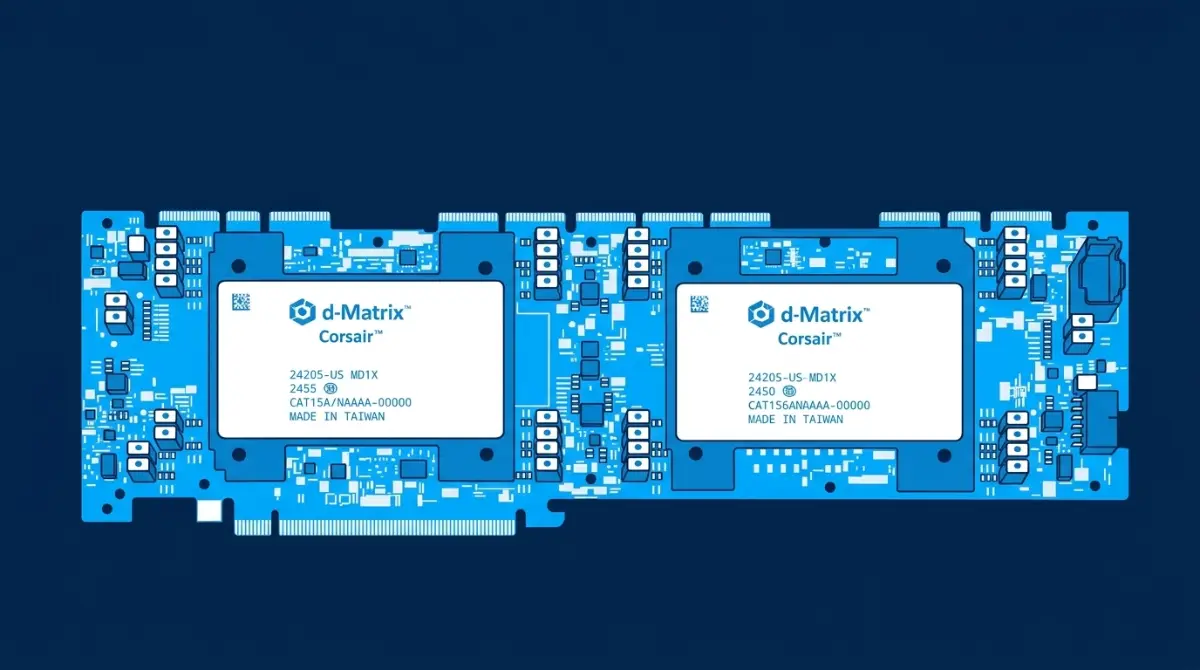


D-Matrix Ties Up With Nvidia On NVLink Server Tech
Silicon startup d-Matrix unites its Raptor processors with Nvidia NVLink server networks to accelerate interactive conversational tokens while challenging traditional memory bottlenecks.
Umar Abubakar | 10 Sept. 2026 · 7 min read

Walking through the humming server rows of a commercial computing facility in Santa Clara four years ago, a systems architect unscrewed the metal faceplate of an accelerator tray. Inside, copper heat pipes converged over rows of square silicon packages. He tapped the PCB board right between the processor and the adjacent memory stack, explaining that every microsecond spent shunting numbers back and forth across those copper traces was bleeding power and stalling responses. The industry had spent billions chasing larger training runs, but the real commercial graveyard was answering live customer queries at scale. When millions of human users demand instant conversational answers, voice replies, or automated software code, standard hardware architectures hit a physical wall. That memory bottleneck has haunted hardware engineers for a generation. Today, an ambitious challenger is teaming up with the dominant sovereign of silicon to rewrite how server racks communicate.
Silicon startup d-Matrix has revealed an alliance with Nvidia to weave its upcoming Raptor inference processors straight into the tech giant’s server hardware. Under the initiative, the startup adopts the proprietary NVLink Fusion interconnect protocol, linking its specialized processors directly with central processing units, high-speed network switches, and liquid-cooled frames built around the standard MGX architecture. The cooperative agreement gives the young hardware firm an accelerated entryway into the global server fleet that dominates commercial data centers worldwide.
My career investigating semiconductor ventures has shown me that young chip companies usually make one fatal mistake: they try to defeat the market incumbent through frontal warfare. Founders spend hundreds of millions engineering an isolated processor, only to discover that data center operators refuse to deploy proprietary server racks that require bespoke electrical hookups and unfamiliar software stacks. Sid Sheth, founder and executive leader of d-Matrix, has chosen a far more pragmatic route. Rather than trying to displace the dominant platform, the startup is plugging directly into its established vascular system.
The Economics of the Inference Explosion
To understand why this technical marriage matters, one must examine the shifting financial calculus across artificial intelligence. For the past four years, the computing conversation centered almost entirely on training: massive, multi-month computational jobs where thousands of interconnected graphics chips ingest petabytes of text to establish neural weights. Hardware for training requires raw brute-force floating-point math, an arena where the market leader established near-total supremacy.
Yet training represents only the capital expenditure phase. The ongoing operating expense sits entirely in inference, the process of running a completed model to answer queries, generate software functions, and process live audio streams. As autonomous software agents and continuous coding tools spread across corporate environments, inference workloads are surging exponentially. The market demands billions of output tokens every hour, and buyers expect responses within fractions of a second.
Inference breaks down into two distinct mechanical phases: prefill and decode. During the prefill stage, the machine absorbs the user’s prompt, a compute-heavy task where standard graphics chips perform admirably. But during the decode phase, when the model generates subsequent tokens one by one, the workload shifts from math computation to memory bandwidth. The processor must pull massive parameter matrices out of memory storage for every single generated word. In conventional servers, data shuttles endlessly between detached memory banks and processor logic, creating severe transmission delays and burning excessive wattage. It is an economic disaster for cloud providers selling flat-rate monthly subscriptions.
Three-Dimensional Memory on the Rack
The Raptor processor attacks that memory wall through an unconventional packaging method. Rather than placing memory chips beside the processor die on a flat planar substrate, the design team stacks dynamic random-access memory directly on top of static storage compute circuits in a three-dimensional, two-story structure. Stacking the memory directly above the processing logic reduces the physical distance electrons travel from inches to microscopic microns.
This vertical integration slashes the energy burned per token while speeding up response generation. By keeping working parameters physically glued to compute gates, the silicon delivers interactive responses for conversational voice agents and software coding tools that choke conventional setups. The startup plans to complete the final design tape-out for Raptor before the end of the year, targeting commercial availability inside server racks by late 2027.
Yet even the fastest chip remains useless if it cannot move data outward to neighboring nodes. This is where the NVLink Fusion agreement alters the equation. Off-the-shelf Ethernet connections introduce transmission lag that fragments memory coherence across multi-chip domains. By adopting sixth-generation NVLink protocols, the startup gains access to three terabytes per second of direct chip-to-chip bandwidth, cutting inter-processor transmission delay by two-thirds compared to standard networking gear.
Working alongside connectivity specialist Astera Labs, the partners are assembling custom interface paths that maintain uniform data flow across the entire rack. Data center operators can split workloads heterogeneously: assigning high-power graphics processors like Vera Rubin to manage the heavy prefill phase, while handing off the time-sensitive decode phase to stacked-memory Raptor units. Each chip handles the specific mathematical task it does best.
The Realities of Corporate Symbiosis
From the perspective of Santa Clara’s dominant chip powerhouse, opening its internal interconnect architecture to outside silicon represents a calculated strategic hedge. For years, critics accused the corporate giant of operating a closed ecosystem, forcing customers to purchase proprietary networking, central processors, and graphics chips as an indivisible bundle. That closed posture drew persistent antitrust scrutiny from international regulators and motivated cloud hyperscalers to fund internal custom silicon programs.
By permitting external processors to link into its server chassis through NVLink Fusion, Jensen Huang is reframing the company from a closed hardware vendor into an indispensable industrial platform. The corporate message is transparent: even if an enterprise prefers specialized silicon for conversational token generation, it must still buy the company’s server racks, purchase its power distribution units, use its BlueField data processors, and route traffic through its ConnectX network controllers. The incumbent collects lucrative hardware toll revenue regardless of whose processing die sits inside the socket.
This collaborative approach echoes broader architectural adjustments across the computing universe. We tracked similar infrastructural realignments when ASUS expanded its server architecture from cloud to edge, and watched venture capital chase hardware differentiation when Andreessen Horowitz led a $300M round for chip startup Gimlet. When compute capital scales into the stratosphere, standalone chip startups must find ways to coexist with the corporate infrastructure footprint already cemented in enterprise facilities.
The Long Road to Commercial Silicon Deployment
While the architectural announcement generates excitement among systems engineers, substantial commercial hurdles remain. Bridging complex multi-vendor hardware into a stable production environment is notoriously difficult. A minor firmware mismatch between third-party memory logic and central network switches can cause server racks to fault, idling expensive compute installations.
Furthermore, d-Matrix must prove it can manufacture complex three-dimensional stacked silicon at commercial yields. Packaging high-density memory directly atop hot compute circuits creates severe thermal dissipation challenges. If heat cannot escape the lower compute layers efficiently, thermal expansion can warp micro-bumps, causing circuit failures. Cleanroom yields on complex 3D semiconductor packages have historically suffered from steep defect rates, which can drive per-unit fabrication expenses beyond commercial viability.
Customer adoption cycles present an additional test. Enterprise cloud operators require twelve to eighteen months of rigorous qualification before allowing unfamiliar silicon to process live customer production workloads. Backing from prominent institutional backers, including Microsoft’s venture vehicle and a $450M funding injection completed last year that pushed the startup's valuation to $2B, provides financial runway. But venture funding cannot bypass the meticulous hardware validation required by enterprise data centers.
This timing also unfolds against monumental infrastructure outlays mapped out across global industry forecasts. Market projections outlined when PwC projected artificial intelligence infrastructure spending to reach $3.1 trillion prove that physical hardware demand will remain historic. Yet only startups that can integrate their components cleanly into operational facilities will survive the coming capital rationalization.
The Industrial Maturation of Computing
The collaboration between d-Matrix and the market leader marks an important maturation point for artificial intelligence infrastructure. The romantic era of believing a single monolithic chip architecture could execute every machine learning workload with equal competence is drawing to a close. High-performance computing is fracturing into specialized domains, where training, prefill, batch analysis, and interactive decoding demand distinct metallurgical and memory choices.
By standardizing on a unified server chassis that accepts specialized accelerator blocks, the hardware industry is moving toward modular, heterogeneous computing. For software creators building responsive digital assistants, voice platforms, and real-time coding tools, this mechanical evolution promises lower token bills and faster user experiences. The battle for silicon supremacy is no longer about declaring an outright winner; it is about building the connective tissue that allows diverse processing brains to work as one.
Read More on TechRobust:

Umar Abubakar
 LinkedIn
Umar Abubakar
Expertise:Editorial Leadership, Product Design (UI/UX), Digital Media Strategy, Technology Systems, Product Architecture
Award:TechRobust Visionary Leader of the Year 2025
Umar serves as Editor-In-Chief and CEO of TechRobust, combining editorial vision with senior product design expertise to shape how modern technology stories are built, packaged, and told. Overseeing all editorial verticals, he directs coverage across global and regional tech landscapes while applying deep design thinking to publication strategy and reader experience.