
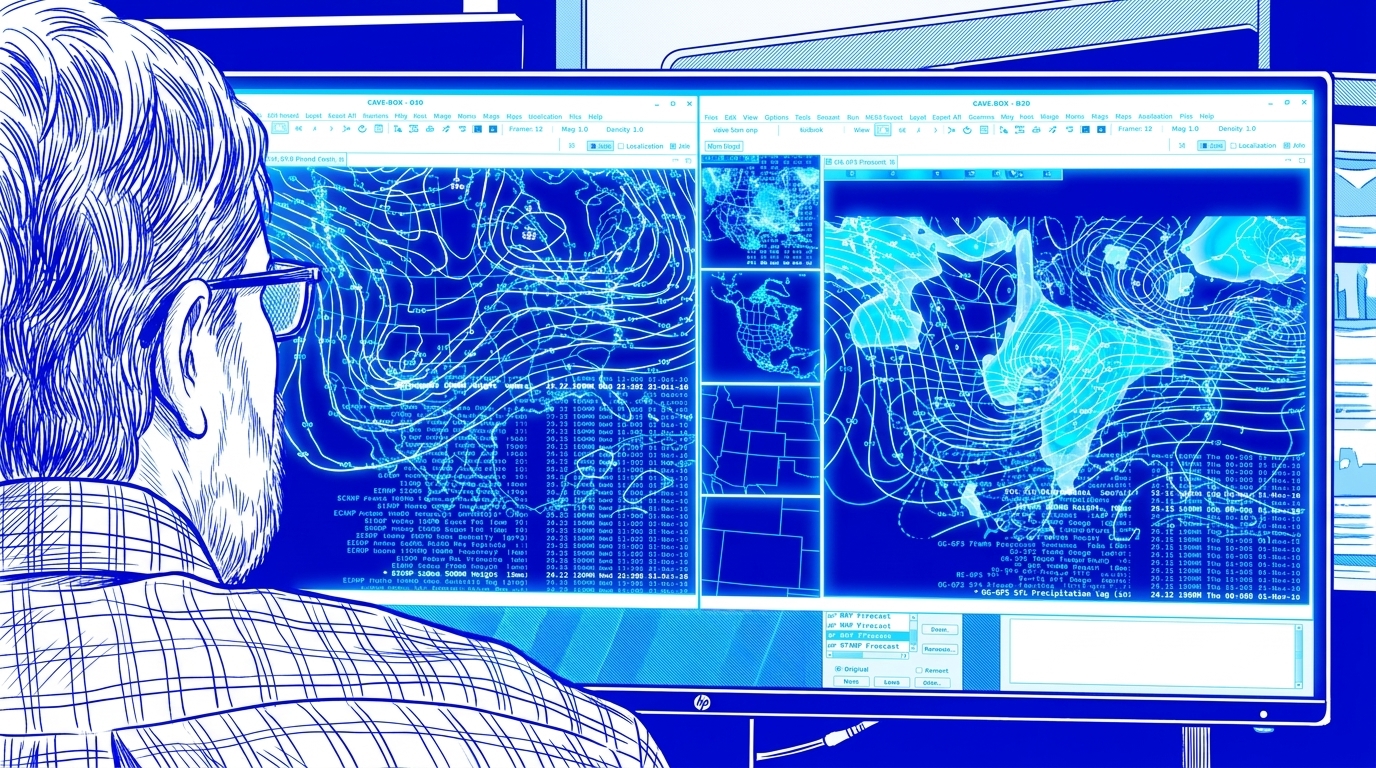


MIT Researchers Build Machine Learning Tool to Predict Unprecedented Weather Disasters
Engineers from the Massachusetts Institute of Technology created a machine learning model that predicts unprecedented weather disasters without needing any historical data for training purposes.
Umar Abubakar | 30 Aug. 2026 · 4 min read

Predicting weather anomalies usually relies heavily on historical records. Meteorologists and data scientists look at past storms to understand what might happen next. But climate conditions are changing rapidly. Global temperatures are rising, creating weather patterns that have no historical precedent. A team of engineers at the Massachusetts Institute of Technology recently introduced a completely new method to address this exact problem. They built a machine learning algorithm capable of mapping out extreme, worst-case weather scenarios even when those exact events have never happened before.
The research, published late last month in Nature Communications, introduces a system called Extreme Event Aware, or eta-learning. Graduate student Kai Chang and Professor Themis Sapsis led the development. Their system answers a highly specific question. If the worst rainfall ever recorded in a city is 200 millimeters, what would a 300-millimeter storm look like? Planners need to know the potential footprint, intensity, and duration of such an event to prepare their infrastructure. Traditional models struggle to provide these answers because they require past examples to generate future predictions. The newly developed tool bypasses this limitation entirely.
How Eta-Learning Processes Weather Information
The system relies on two distinct types of information to build its predictions. First, it uses point statistics. These statistics track how frequently a specific intensity level occurs within a localized area. Second, the algorithm processes spatial maps, which show how a weather event spreads across a physical region. By combining these two inputs, the model learns the mathematical relationship between isolated statistics and broader geographical impacts.
During testing, the researchers focused on precipitation across the continental United States. They gathered 25 years of hourly rainfall measurements and condensed them into daily maps. To prove the model could function without relying on extreme historical data, the team restricted the training period for the spatial component. They only fed the algorithm six months of paired low-resolution and high-resolution maps. This short timeframe contained almost no examples of severe storms. The machine learning model simply learned how broad weather patterns translated into high-resolution details.
After learning these base patterns, the algorithm applied the point statistics from the full 25-year record. These statistics act as a mathematical boundary, keeping the generated scenarios grounded in reality. The software can then produce thousands of variations of a once-in-a-century storm. Each generated map features a unique size, shape, and intensity distribution. Urban planners can review these variations to see the many different ways a disaster might strike their city.
Protecting Vulnerable Infrastructure
Designing physical defenses against natural disasters requires accurate estimates of what those disasters will look like. Seawalls, drainage systems, and power grids all have maximum limits. When a storm exceeds those limits, the results are catastrophic. According to Sapsis, modern supply chains and utility networks are heavily constrained. They leave very little room for error. A single severe event can cause disruptions that ripple through food supplies and energy markets for weeks.
With this new software, civil engineers do not have to guess how a record-breaking heatwave or hurricane might behave. They can ask the system to generate a specific frequency event, such as a storm likely to happen once every hundred years. The software returns thousands of statistically plausible maps. City officials can then simulate how their current infrastructure holds up against these generated models. If the simulation shows widespread flooding in a specific neighborhood, the city can build targeted reinforcements long before a real storm arrives.
You can read more about how artificial intelligence is changing related scientific fields by visiting recent technology coverage from Reuters, which tracks similar advancements in data modeling.
Future Applications Beyond Rainfall
The current demonstration focused strictly on rainfall and precipitation in the United States. But the researchers built the underlying mathematics to be adaptable. As long as researchers can provide the correct point statistics and spatial maps, the eta-learning method can generate scenarios for almost any type of disaster. The team plans to adapt the software to model extreme wildfires and massive flood events.
The concept even extends beyond natural disasters. The engineers noted that the same mathematical principles apply to large, human-made systems. Financial market crashes, for instance, behave like extreme weather events. They are rare, highly destructive, and involve many interacting variables. The software could potentially stress-test stock markets or banking systems against unprecedented economic shocks. Similarly, developers working on autonomous robotics could use the algorithm to simulate rare navigational hazards, ensuring self-driving vehicles know how to react to situations they have never encountered on real roads.
Providing a mathematical probability for events that have not happened yet is a massive step forward for predictive modeling. As climate conditions continue to shift away from historical norms, tools like the one developed at the Massachusetts Institute of Technology will become standard requirements for national safety and economic planning.

Umar Abubakar
 LinkedIn
Umar Abubakar
Expertise:Editorial Leadership, Product Design (UI/UX), Digital Media Strategy, Technology Systems, Product Architecture
Award:TechRobust Visionary Leader of the Year 2025
Umar serves as Editor-In-Chief and CEO of TechRobust, combining editorial vision with senior product design expertise to shape how modern technology stories are built, packaged, and told. Overseeing all editorial verticals, he directs coverage across global and regional tech landscapes while applying deep design thinking to publication strategy and reader experience.