
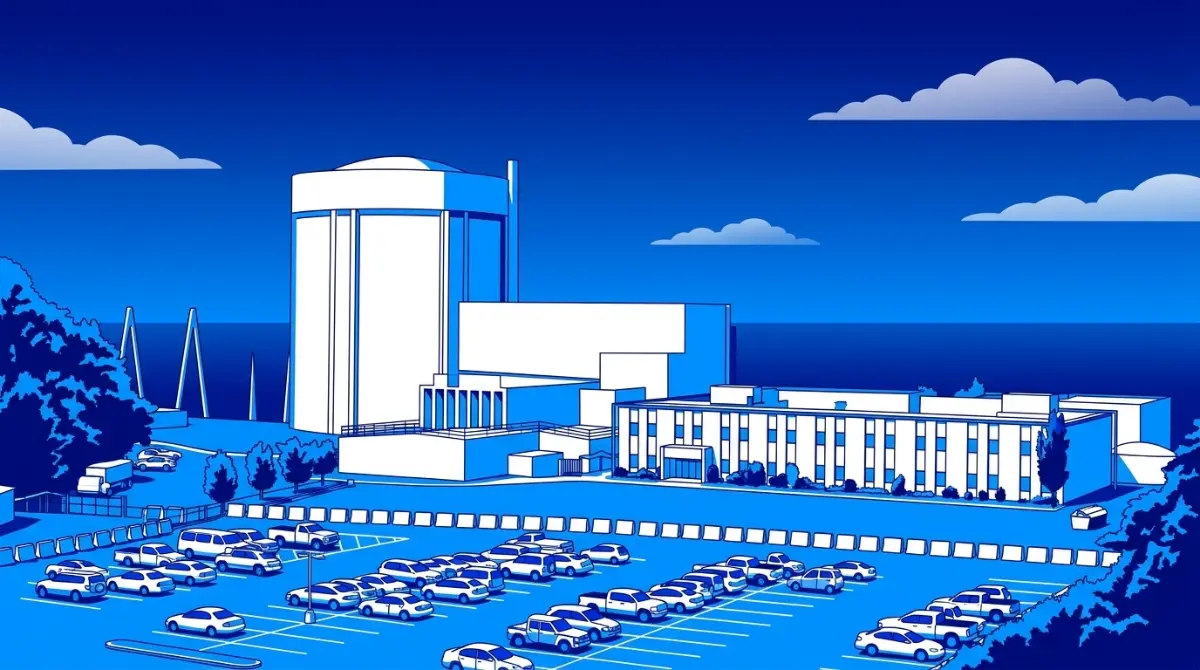


Nuclear Power Faces Its Ultimate Test in AI Data Centers
Silicon Valley giants are turning to atomic reactors to fuel massive compute campuses, exposing deep manufacturing bottlenecks, fuel shortages, and regulatory hurdles across the energy sector.
Umar Abubakar | 14 Sept. 2026 · 10 min read

Step onto the gravel access roads surrounding Loudoun County, Virginia, and you will hear a distinct mechanical hum that never sleeps. It is the sound of dozens of warehouse-sized server facilities drawing gigawatts from local electrical substations to train artificial intelligence algorithms. For fifteen years, I have tracked how computing hardware reshapes physical geography, watching quiet farmland transform into dense clusters of concrete and fiber optic lines. Today, that digital growth has collided with physical reality. Regional utility operators cannot build transmission wires or coal replacements fast enough to keep up with server racks that consume electricity like industrial aluminum smelters. The global compute boom has exhausted the electrical grid, forcing technology executives to wager billions on atomic energy.
Every major software empire now promotes nuclear power as the clean savior of automated intelligence. Microsoft signed a twenty-year agreement worth $16B with Constellation Energy to resurrect the dormant Unit 1 reactor at Pennsylvania's Three Mile Island. Google committed to purchasing electricity from a proposed fleet of small modular reactors designed by Kairos Power. Amazon paid $650M for an industrial campus adjacent to the Susquehanna atomic station. Yet beneath these polished press statements lies an uncomfortable industrial truth. Restarting retired facilities is a temporary fix, not a permanent strategy. The genuine test for the technology sector is whether it can build new advanced reactors at commercial scale before power shortages throttle compute growth entirely.
The Collision of Two Incompatible Timelines
When you sit with software engineers in Seattle or the Bay Area, project schedules are measured in two-week sprints. Code is written, tested, and shipped to server nodes before sunrise. If a server facility needs more compute, technicians slide high-density graphics processors into chilled server racks within months. The software world operates on compressed clocks, convinced that capital and code can overcome any technical hurdle.
The nuclear sector operates on geological time. Licensing, engineering, financing, and pouring concrete for a commercial atomic power station historically consumes ten to fifteen years. Regulators must review thousands of pages of structural calculations, seismological evaluations, and emergency cooling blueprints before a construction crew can dig a foundation trench. When you force a technology industry running on six-month release cycles to depend on an energy sector moving at the pace of federal administrative hearings, friction is inevitable.
Industry planners are discovering that money alone cannot accelerate physical construction. You can raise billions from venture funds in a matter of weeks, as demonstrated when Crusoe secured a $3B funding round at a $30B valuation for data centers, but capital cannot instantly train certified reactor welders, manufacture specialized pressure vessels, or clear decades of bureaucratic review. Silicon Valley wants immediate energy to train next-generation models, while reactor developers are asking for patience that Wall Street does not possess.
Beyond the Spectacle of Facility Restarts
Corporate executives celebrate reactor restarts because they represent the path of least resistance. Reactivating an existing facility like Three Mile Island Unit 1 avoids the brutal gauntlet of selecting new real estate, securing local municipal clearances, and building intake pipes from scratch. The cooling towers are standing, the concrete containment structures remain sound, and the high-voltage switchyards already link directly to regional transmission networks.
Yet the United States has very few retired reactors that can be salvaged. Most closed facilities have had their internal plumbing removed, their turbine halls demolished, or their cooling licenses permanently surrendered. The low-hanging fruit of the nuclear restart trend will be picked clean before the end of the decade. Once those legacy megawatts are absorbed, technology developers will have to construct new reactors from scratch on open ground.
Building new atomic generation is where modern Western engineering has struggled for forty years. The expansion of Plant Vogtle in Georgia saw Units 3 and 4 arrive seven years behind schedule, with construction costs ballooning past $35B. Commercial utility operators walked away from conventional gigawatt-scale projects after watching contractors absorb historic cost overruns. Technology corporations claim their capital will prevent similar catastrophes, but managing heavy civil engineering projects requires expertise that software developers simply do not possess.
The Promises and Perils of Small Modular Reactors
To avoid the financial quicksand of traditional mega-reactors, the technology sector has embraced the concept of small modular reactors, commonly called SMRs. The concept sounds ideal for hyperscale computing: build compact reactors inside controlled factory environments, transport the modular components on flatbed railway cars, and assemble them on-site next to data centers. By building standardized units repeatedly, manufacturers promise to drive down fabrication costs through assembly-line discipline.
Startups such as Kairos Power, Oklo, and X-energy have captured Silicon Valley's imagination with designs utilizing molten salt, liquid metal, or helium gas rather than conventional pressurized water. These advanced systems operate at atmospheric pressure and rely on passive physical mechanisms, like natural thermal convection, to shut down safely during power failures without human intervention or emergency pumps.
The concept is mechanically sound, but turning CAD designs into commercial reality is proving difficult. Developing an entirely new reactor architecture requires building non-nuclear test facilities, validating computational fluid dynamics models, and convincing cautious regulators that novel fuel forms will perform safely over decades. When companies attempt to compress that validation process to meet server deployment schedules, safety watchdogs push back. The industry has spent hundreds of millions of dollars on exploratory agreements and public announcements, yet not a single commercial advanced modular reactor is generating electricity on the American commercial grid today.
The Geopolitical Trap of Fuel Supply Chains
If you examine the technical blueprints of these proposed advanced reactors, you uncover an even more dangerous bottleneck: fuel. Most advanced modular designs do not run on the low-enriched uranium used by commercial light-water plants. They require High-Assay Low-Enriched Uranium, known as HALEU, which is enriched up to 20 percent with uranium-235 to allow compact cores to run longer without refueling.
Until recently, the only commercial supplier capable of producing HALEU at industrial scale was Tenex, a subsidiary of Russia's state atomic energy corporation Rosatom. Following geopolitical sanctions and trade bans enacted by Western governments, Western tech companies cannot ethically or legally rely on Moscow to fuel the reactors intended to power their domestic computing clusters. Building domestic enrichment infrastructure takes years of chemical engineering and billions in capital investment.
Centrus Energy has started operating a demonstration cascade of specialized centrifuges in Piketon, Ohio, but domestic production remains a trickle compared to what a fleet of commercial reactors will consume. Without guaranteed supplies of enriched fuel, nuclear startups cannot validate their core designs or secure bankable operating licenses. The technology industry finds itself trapped in a chicken-and-egg dilemma: enrichment firms will not invest billions in large centrifuge halls without signed reactor contracts, while reactor manufacturers cannot finalize their customer agreements without guaranteed fuel deliveries.
The Regulatory Gauntlet in Washington
The Nuclear Regulatory Commission, headquartered in Rockville, Maryland, was designed after the atomic disasters of the twentieth century to prioritize public safety above all else. Its administrative culture is conservative, methodical, and deliberately immune to corporate hype. For safety regulators, moving slowly is a feature of their public mandate, not a defect.
Technology lobbyists frequently complain that current regulatory frameworks are archaic, designed exclusively for massive light-water reactors built in the 1970s rather than compact modular systems. While Congress passed legislation directing regulators to modernize their review pipelines for advanced technologies, the agency refuses to rubber-stamp novel reactor designs. When Oklo submitted its initial custom application for the Aurora powerhouse in Idaho, regulators denied the paperwork without prejudice because the company failed to provide sufficient technical data regarding safety systems and accident scenarios.
Navigating this regulatory process costs tens of millions of dollars and requires years of back-and-forth technical audits. For software firms accustomed to pushing updates without asking government permission, submitting to federal safety inspections is a painful cultural shock. Even if a design receives an initial construction permit, building an operating plant requires passing continuous structural inspections, seismic tests, and containment certifications before fuel rods can be loaded into the core.
Grid Congestion and Public Backlash
While tech giants promote atomic energy as a clean climate solution, public resistance is building in the communities slated to host these facilities. Data centers consume massive quantities of water for evaporative cooling towers, straining local municipal aquifers. When tech companies propose building on-site nuclear reactors next to sprawling server campuses, nearby residents express sharp concerns regarding emergency evacuation routes, radioactive waste storage, and plummeting property values.
Furthermore, connecting massive data centers directly to existing atomic stations creates friction with regional consumer ratepayers. When Amazon purchased the campus next to the Susquehanna station, local utilities and consumer advocacy groups raised formal objections with the Federal Energy Regulatory Commission. They argued that siphoning nuclear electricity behind the meter to power commercial servers deprives the broader regional grid of clean baseload power, forcing ordinary households to pay higher electric bills as utilities fire up older natural gas plants to balance the system.
These disputes highlight a growing moral dilemma. Why should public power grids be distorted, and regional consumer electricity rates increased, simply to provide computing capacity for corporate software agents and chatbot interfaces? If technology corporations want dedicated atomic power, regulators must ensure that local taxpayers do not subsidize the transmission lines or bear the environmental burdens of continuous server operation.
Financial Realities and Macroeconomic Pressures
The scale of capital required to build a domestic nuclear ecosystem is staggering. Analysts predict that global compute infrastructure spending will consume trillions over coming decades, an investment curve we detailed when PwC predicted AI infrastructure investment would reach $31T by 2050. Yet building capital-intensive infrastructure during periods of fluctuating interest rates tests corporate balance sheets.
Unlike software development, where marginal costs approach zero once code is written, atomic power stations require enormous upfront capital investments before generating a single kilowatt of electricity. If construction costs escalate or interest rates remain elevated, the debt service on an unfinished nuclear campus can drag down corporate earnings. Financial markets are already showing caution regarding massive technology capital expenditures, forcing boards to justify whether dedicated nuclear energy delivers competitive commercial returns compared to regional grid power purchase agreements.
Tech giants are also watching how international competitors manage their energy requirements. In Europe, where industrial electricity prices are high, tech companies are flocking to northern territories with abundant hydro and atomic infrastructure, a movement we analyzed when Finland became Europe's data center hub with $30.2B in strategic bets. If American regulatory delays make domestic nuclear power too expensive or slow to deploy, cloud providers will simply build their largest computing clusters overseas, following accessible power across international borders.
The Road Toward Commercial Realism
The race to pair atomic reactors with server farms represents a defining moment for the modern industrial economy. For decades, the digital revolution operated under the fantasy that software was weightless, that computing happened in a magical cloud detached from physical resources. The energy crisis facing modern data centers has shattered that illusion. Artificial intelligence is physical. It relies on concrete, copper, high-purity water, and enriched uranium.
If the nuclear resurgence is to become more than a public relations narrative, the technology sector must move past speculative announcements and commit to the hard, unglamorous work of industrial rebuilding. Tech firms must fund domestic uranium enrichment cascades, invest in automated manufacturing facilities for pressure vessels, and partner transparently with federal safety regulators rather than trying to circumvent them. They must also work directly with local host communities, proving that corporate computing campuses can create stable regional employment without endangering public safety or exhausting municipal water supplies.
Silicon Valley has spent the last decade disrupting the digital realm. Now, it must learn to navigate the unforgiving laws of atomic physics, heavy manufacturing, and public regulation. The server racks are waiting, the power lines are hummed to their limits, and the atomic age has returned to claim its place at the center of the technological frontier.
Read More on TechRobust:

Umar Abubakar
 LinkedIn
Umar Abubakar
Expertise:Editorial Leadership, Product Design (UI/UX), Digital Media Strategy, Technology Systems, Product Architecture
Award:TechRobust Visionary Leader of the Year 2025
Umar serves as Editor-In-Chief and CEO of TechRobust, combining editorial vision with senior product design expertise to shape how modern technology stories are built, packaged, and told. Overseeing all editorial verticals, he directs coverage across global and regional tech landscapes while applying deep design thinking to publication strategy and reader experience.