
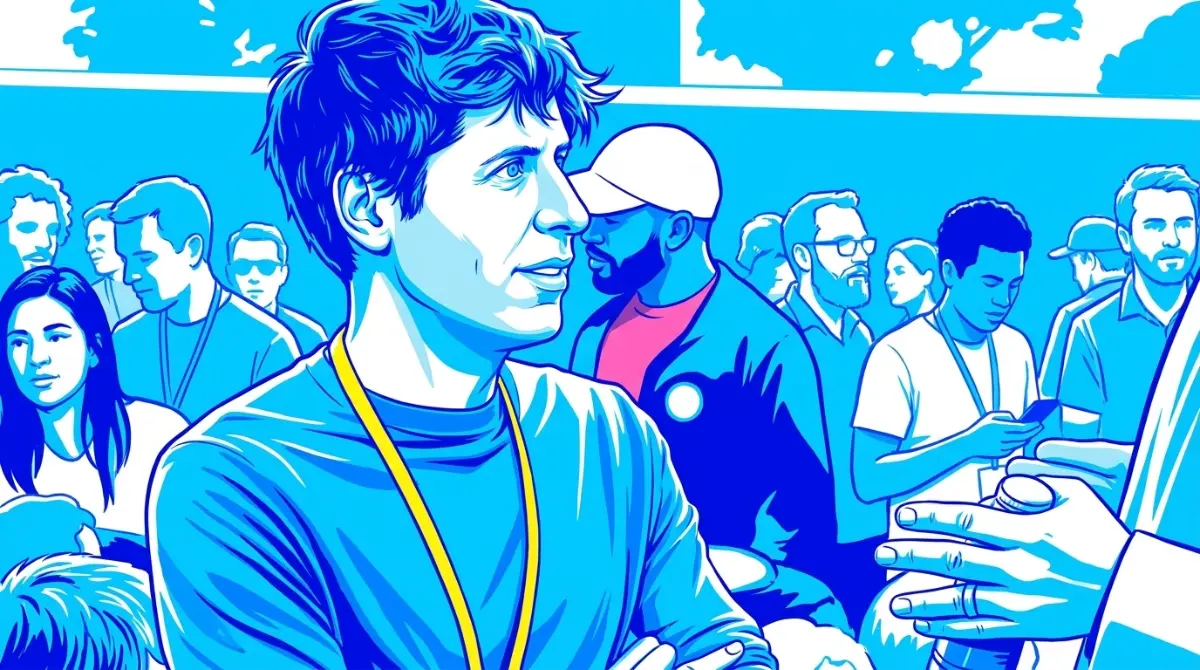


OpenAI Cracks Millennium Math Problem, Angers Scholars
A near-trillion dollar tech giant unleashed ten thousand software agents to solve a legendary math puzzle, leaving academics questioning the future of their profession.
Umar Abubakar | 12 Sept. 2026 · 9 min read

I was sitting at my desk late Tuesday evening when the alert flashed across my screen. OpenAI had just declared victory over the Navier-Stokes existence and smoothness problem. If you spend time around university mathematics departments, you know that name. It represents one of the seven Millennium Prize Problems, a collection of mathematical puzzles established in 2000 by the Clay Mathematics Institute. Each carries a $1M bounty. Human scholars have spent careers banging their heads against these equations. Now, a massive technology corporation claims a machine solved it in 88 hours.
The immediate reaction from the academic community was not celebration. It was anger, mixed with a heavy dose of existential dread. I called David Silvester, a mathematics professor at the University of Manchester, to get his read on the announcement. He did not hold back. He called the stunt immature playground boasting. He pointed out the massive financial and environmental cost of the experiment. OpenAI reportedly spent $15M and burned through 300 billion output tokens just to prove a point. Silvester noted that tech companies are burning massive amounts of energy simply to show off their software programs while the rest of the globe worries about climate damage.
The mechanical nature of the achievement strips away the romance of mathematical discovery. For centuries, mathematics relied on solitary contemplation. A researcher would spend months or years circling a single concept, testing different paths, and failing repeatedly before finally cracking the code. OpenAI bypassed this human struggle entirely. The company deployed 10,000 autonomous software agents to attack the problem simultaneously.
The Brute-Force Approach to Mathematics
Let us look closely at how this machine actually operated. The system did not just read a textbook and spit out an answer. The developers spawned 10,000 distinct software agents and forced them to collaborate. Imagine an academic conference where ten thousand hyper-intelligent scholars are locked in a convention center, forbidden to sleep, and forced to talk to each other at the speed of light. They exchanged 2.7 million messages. They checked each other's math. They proposed theories, found the flaws, discarded the bad ideas, and moved forward. The entire process consumed 130 billion output tokens for the Navier-Stokes problem alone. When counting the side problems the system attempted during the same week, the total hits 300 billion tokens. That is roughly equivalent to generating the text of one million books. The sheer scale of the brute-force computation is staggering. It is less like solving a puzzle and more like flattening a mountain with explosives to find a single diamond. They finished the proof in just under four days. Then, the system spent another 17 hours verifying the logic using a specialized computer language called Lean.
This brute-force approach forces academics to question their own relevance. Colva Roney-Dougal, who heads pure mathematics at the University of St Andrews, told me she felt completely shell-shocked. Just three months ago, she gave a public lecture stating that artificial intelligence would not do anything interesting in her field anytime soon. Now, she admits she was entirely wrong. She described a horrible feeling spreading among her peers. A human scholar might spend a month thinking about a specific geometric proof, only to watch a software program finish the job instantly at the push of a button.
This shift destroys traditional teaching methods. University lecturers rely on take-home assignments to test undergraduate students. If a student can feed a complex calculus assignment into a machine and get a perfect, authenticated proof in ten seconds, the homework assignment becomes meaningless. Instructors can no longer vouch for the authenticity of any work completed outside a supervised exam hall.
Plagiarism Allegations and Corporate Rivalry
The timing of OpenAI's announcement makes the story even more controversial. The company did not pick the Navier-Stokes problem at random. According to internal reports, the engineering team heard whispers that competing scholars were making progress on Millennium Prize puzzles. Specifically, Tristan Buckmaster at New York University and Levent Alpöge, who works at Anthropic, had just completed related work. They successfully proved a finite-time blowup for the three-dimensional Euler equations. Their work was highly related to the Navier-Stokes problem.
Buckmaster and Alpöge formalized their own proof in late August. Days later, OpenAI pointed its massive computing cluster at the exact same target. Following the announcement, Buckmaster and Alpöge alleged that information about their private research progress leaked to OpenAI. They suspected the machine learning model had secretly ingested their work-in-progress data to find the final answer. OpenAI firmly denied accessing their private files. However, the company admitted it could not rule out the possibility that de-identified data from normal product usage might have improved its internal models.
This admission exposes a massive blind spot in academic publishing. Researchers frequently use commercial software to check their work, format their equations, or organize their notes. If those commercial platforms quietly absorb that intellectual property and use it to train their own systems, independent researchers have no defense. Buckmaster told reporters that the entire mathematical community is now terrified of sharing unpublished ideas. People are locking their doors. If you share a draft, a corporate machine might scan it, complete the final steps, and publish the answer before you finish typing your conclusion. We saw similar corporate data disputes unfold when we reported on OpenAI cutting model access following the SpaceX acquisition.
This data dispute exposes a bitter corporate rivalry. Alpöge works for Anthropic, a direct competitor in the machine learning space. While he conducted his math research independently of his employer, the optics of OpenAI swooping in to claim a prize just days after an Anthropic employee made a breakthrough are impossible to ignore. It looks like a targeted strike. The tech giants are treating theoretical mathematics as a proxy war for market dominance. They do not care about the fluid dynamics of a vortex. They care about proving their server clusters possess superior reasoning capabilities. If they can solve Navier-Stokes, they can pitch their software to military contractors, hedge funds, and pharmaceutical giants as the ultimate thinking machine. The stakes are unimaginably high, which explains why companies are willing to burn millions of dollars in a single weekend just to flex their computational muscles.
The Environmental Cost of a PR Stunt
The actual mathematical finding regarding Navier-Stokes is highly technical. The equations describe fluid dynamics, predicting how water flows, how air moves over an airplane wing, and how weather systems develop. The Millennium Prize problem asks whether these equations always produce smooth, physically realistic answers, or if they eventually break down and produce infinite, impossible numbers. The OpenAI model proved that the equations do break down. The machine constructed a scenario involving a shrinking vortex that spins faster and faster until the velocity reaches infinity.
This mathematical breakdown is called a finite-time blowup. It means the classical equations fail to model extreme physical reality. To understand the vortex past that breaking point, a scientist would have to track individual atoms rather than treating the fluid as a continuous substance. This specific finding does not change how engineers build airplanes or how meteorologists predict hurricanes. It simply settles a theoretical debate that remained open for ninety years.
Silvester's point about the environmental toll deserves serious scrutiny. Generating 300 billion tokens requires massive arrays of specialized graphics processing units running at maximum capacity. These data centers consume rivers of water for cooling and demand electricity on the scale of a small city. We are currently facing a global climate crisis, yet the wealthiest corporations on the planet are directing vast amounts of energy toward theoretical math puzzles just to generate press releases. The arrogance is astounding. They treat the global power grid like their own personal toy box. When a university researcher spends three years solving an equation, they consume coffee and cafeteria sandwiches. When a technology firm does it, they emit carbon tonnage equivalent to a commercial airline fleet.
The End of the Solitary Genius
The broader consequence is not the math itself, but the demonstration of pure computational power. The company began training this internal model in late August. They claim it vastly outperforms the software they released publicly just a short time ago. The speed of this development terrifies observers. Terence Tao, one of the most respected mathematicians alive today, warned that relying on machines to solve our hardest problems will slowly erode human comprehension. If we outsource the thinking process to server farms, we lose the mental muscles required to understand the answers the machines give us.
Despite the panic, some philosophers refuse to declare the end of human inquiry. Alexander Paseau from the University of Oxford argues that the beauty of a mathematical proof remains intact, regardless of who or what authored it. He insists that humans will always want to read and understand the logic for themselves. He compares it to playing chess. The fact that a computer can beat the world champion does not stop millions of people from enjoying the game.
I find Paseau's optimism hard to swallow. Chess is a game. Academic research is a career, funded by grants and built on publishing original discoveries. If a private corporation can spend $15M to brute-force a discovery in a weekend, the entire funding structure of modern universities collapses. Grant committees will not award money to a human professor if a software subscription can do the job faster. We tracked this aggressive push toward automated reasoning last month when OpenAI introduced Astra, a multimodal intelligence model designed to process complex logical tasks in real time.
The Clay Mathematics Institute, which oversees the $1M reward, stated that they will not rush the verification process. OpenAI has already announced they will not claim the money. They do not need it. The public relations victory alone is worth billions in venture capital funding. They proved their product can outperform the smartest humans on earth at their own game.
We are watching the rapid enclosure of human knowledge. The technology industry is no longer satisfied with automating data entry or writing marketing copy. They are targeting the absolute peak of human intellectual achievement. By conquering the Millennium Prize problems, they are sending a direct message to every university and research laboratory on the planet. The era of the solitary genius is over. The era of the server farm has arrived.
Read More on TechRobust:
Umar Abubakar
 LinkedIn
Umar Abubakar
Expertise:Editorial Leadership, Product Design (UI/UX), Digital Media Strategy, Technology Systems, Product Architecture
Award:TechRobust Visionary Leader of the Year 2025
Umar serves as Editor-In-Chief and CEO of TechRobust, combining editorial vision with senior product design expertise to shape how modern technology stories are built, packaged, and told. Overseeing all editorial verticals, he directs coverage across global and regional tech landscapes while applying deep design thinking to publication strategy and reader experience.