
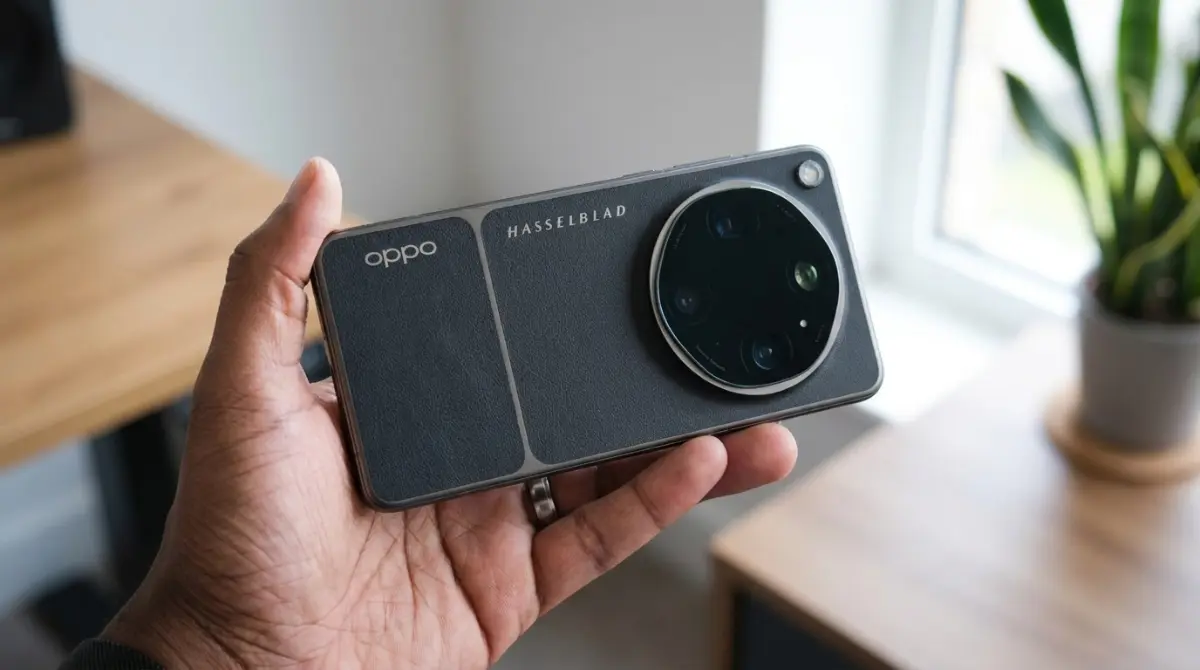


Oppo Find X10 Debut Set for September 22 With Triple 200MP
Oppo confirmed a September 22 debut for the Find X10 line, packing three two-hundred megapixel sensors onto its flagship to outmuscle Western camera phones.
Umar Abubakar | 15 Sept. 2026 · 5 min read

For three years, Western phone makers told consumers that sensor resolution had hit a practical ceiling. Apple and Google settled into forty-eight and fifty-megapixel sensors, insisting that software algorithms could handle the rest. Chinese hardware laboratories refused to accept that compromise. Engineers in Guangdong spent their nights stacking silicon dies, carving periscope channels out of glass prisms, and testing multi-element lenses that stretch the boundaries of pocket electronics. On Monday, September 14, 2026, Oppo officially set September 22 as the launch date for the Find X10 family in China, showing off a camera array boasting three separate 200MP sensors on its premier model.
The announcement confirms weeks of industry leaks regarding the Find X10 Pro Max, standard Find X10, and an accessible Find X10 E. Retail reservations opened immediately across Chinese domestic channels, accompanied by the announcement of companion hardware including the Watch S2 and Enco X4 wireless earbuds. While competitors refine slight exterior changes, this release represents an aggressive technological leap. Fitting three distinct 200MP imagers behind wide, periscope telephoto, and ultrawide lenses changes how a smartphone captures light, challenging the software processing model favored by American hardware giants. You can observe how competing brands handle mobile camera hardware and pricing by reading our analysis of how flagship builders balance premium pricing and chassis density.
The Physics Behind Three 200MP Sensors
To grasp what makes this optical arrangement extraordinary, you have to look at the mechanical constraints inside a modern smartphone chassis. Packing one large sensor into a pocket-sized device requires careful thermal and spatial engineering. Packing three high-resolution sensors onto a single camera plateau forces hardware architects to redesign internal motherboards completely.
The standout Find X10 Pro Max uses a 200MP primary sensor with custom optical stabilization, paired with a 200MP periscope telephoto lens built around a 1/1.56-inch Samsung ISOCELL sensor, alongside a third 200MP sensor dedicated entirely to the 124-degree ultrawide glass. Rather than forcing the secondary cameras to rely on smaller twelve-megapixel chips that produce grainy night shots, every focal length preserves uniform color science, identical pixel-binning ratios, and deep light collection. Whether shooting distant architectural cornices at 5x optical zoom or capturing wide landscape horizons at dusk, the pipeline processes uniform high-resolution detail. This hardware-heavy philosophy runs counter to Silicon Valley trends, where companies rely on software to fake optical clarity, a tension we explored when Huawei challenged mobile photography boundaries with advanced multi-lens glass.
Abandoning Circular Dials for Rectangular Plateaus
Beyond sensor counts, the external shell reveals a dramatic visual redesign. For several generations, the brand anchored its premier devices around massive circular glass dials centered on the rear panel. That familiar circular aesthetic has been scrapped. Official renders show a return to a rectangular camera plateau positioned in the upper corner, featuring two distinct architectural housings.
On the Find X10 Pro Max, a square module holds the trio of 200MP lenses, while an adjacent pill-shaped strip encloses the multi-tone LED flash, color temperature sensors, and laser autofocus transmitters. The phone will ship in Moon White, Light Titanium, and Warm Orange, framed by an expansive OLED front screen with uniform 1.15mm borders that make the display glass spill over the edges. The standard Find X10 shares the same split-plateau aesthetic in Ice Blue, Clear Orange, and Light Titanium, while the Find X10 E retains a single unified square housing reminiscent of earlier models. We examined how industrial design shifts impact daily usability in our coverage of split-screen multitasking and chassis ergonomics.
Silicon Choices and Power Management
Feeding three 200MP sensors generates staggering data flows that can choke ordinary mobile processors. Processing a single multi-frame exposure from a 200MP array requires billions of operations per second, demanding specialized image signal processors and fast neural engines. Under the glass, upper-tier models will run on MediaTek's flagship Dimensity silicon built on advanced fabrication processes, paired with up to 16GB of fast memory and 1TB of onboard storage.
Handling those data pipelines alongside high-refresh 2K displays drains batteries quickly. To prevent dead devices before evening, engineering teams installed dual-cell silicon-carbon battery packs totaling an enormous 8,000mAh capacity inside the upper models. By moving away from standard graphite chemistries toward high-density silicon-carbon blends, the manufacturer squeezed laptop-class energy reserves into a chassis under nine millimeters thick. Rapid wired charging ensures the expansive power cell recharges in under thirty minutes, addressing the chronic battery anxiety that plagues mobile creators who shoot high-resolution video throughout the workday.
The Global Distribution Question
The scheduled presentation arrives at an interesting moment for international trade. Western markets remain largely cut off from these specialized optical flagships due to carrier distribution cartels and regulatory trade barriers. American consumers looking for cutting-edge photography must choose between incremental updates from Apple, Google, and Samsung, while Asian consumers enjoy rapid hardware competition featuring massive batteries, custom silicon, and professional-grade camera sensors.
While the September 22 reveal targets the domestic Chinese retail market first, international hardware watchers anticipate a broader overseas rollout across Europe and Southeast Asia in early 2027. If the real-world image samples match the bold hardware specifications on paper, the Find X10 Pro Max will put intense pressure on established legacy brands to stop skimping on secondary camera sensors. The era of treating ultrawide and zoom lenses as secondary accessories is coming to an end, pushed aside by devices that treat every focal length like a professional camera.
To inspect the initial launch date disclosure and early retail specifications, you can review the reporting on Android Authority.
Read More on TechRobust:

Umar Abubakar
 LinkedIn
Umar Abubakar
Expertise:Editorial Leadership, Product Design (UI/UX), Digital Media Strategy, Technology Systems, Product Architecture
Award:TechRobust Visionary Leader of the Year 2025
Umar serves as Editor-In-Chief and CEO of TechRobust, combining editorial vision with senior product design expertise to shape how modern technology stories are built, packaged, and told. Overseeing all editorial verticals, he directs coverage across global and regional tech landscapes while applying deep design thinking to publication strategy and reader experience.