
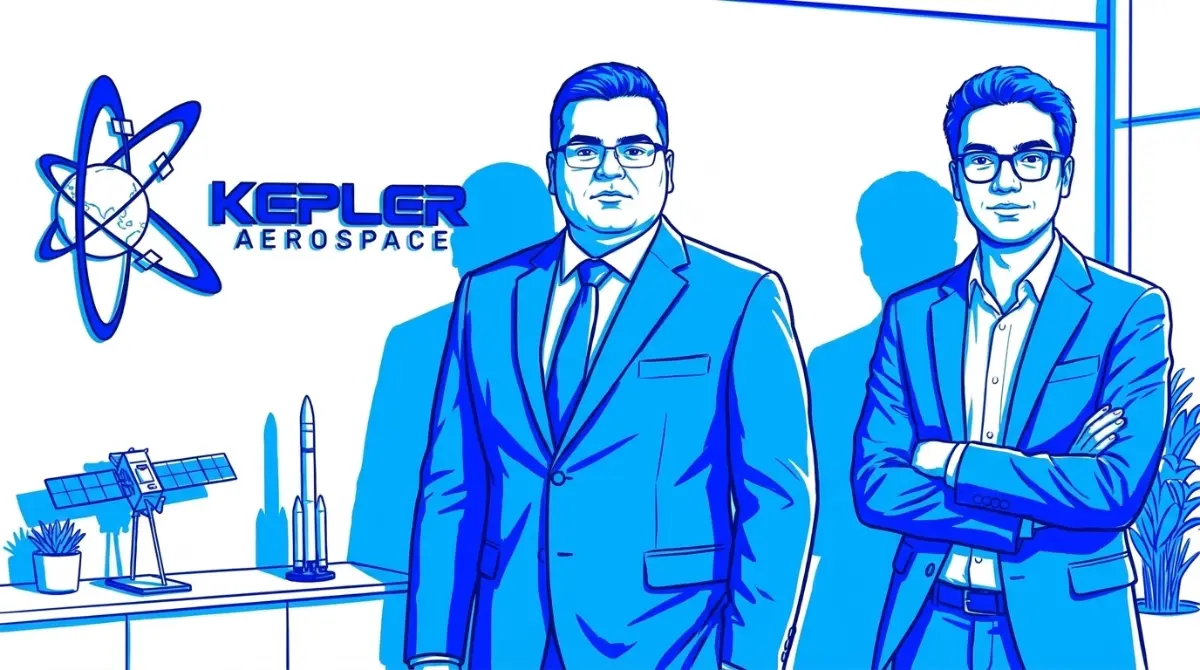


Kepler Aerospace Secures $8M Seed Funding for Autonomous Military Satellites
The Bengaluru-based space technology organization raised an $8M financial round to launch an autonomous network of military surveillance satellites for the Indian government.
Inioluwa Ademidun | 3 Sept. 2026 · 2 min read

Kepler Aerospace recently closed an $8M seed financing round to accelerate the production of its orbital defense network. Blue Ashva Capital led the financial injection, with Finvolve and India Accelerator co-leading the investment. Founded in 2018, this represents the first time the Bengaluru-based space infrastructure organization has accepted outside capital. The executive team plans to direct these funds toward deploying a specialized network of six surveillance satellites for the Indian Defence Space Agency.
Building an Autonomous Orbital Swarm
Modern military operations require constant, immediate surveillance data. Traditional satellite networks often rely heavily on commands from ground stations, slowing down how quickly images reach military commanders. Chief Executive Officer Navneet Singh and Chief Strategy Officer Kiran Sharma designed a system that bypasses these communication delays. Their upcoming constellation operates as a self-coordinating swarm. The satellites can detect a target on the ground, communicate with one another, and adjust their sensors without waiting for human instructions.
The hardware will carry thermal, electro-optical, and electronic warfare sensors. If one satellite spots a moving ship or a mobile air-defense battery, it instantly alerts the rest of the network to track the object. According to company leadership, this automation could reduce the time it takes to deliver usable military intelligence from forty-five days down to just a few hours. Funding hardware that operates completely independently requires massive capital, a pattern we also tracked when a16z launched a fund specifically for physical computing infrastructure.
Government Contracts and Expansion
The startup already secured significant backing from the Indian government before this seed round. Kepler Aerospace holds two major contracts under the Innovations for Defence Excellence platform, which previously provided $4M in early technology grants. The engineering team expects to launch the first six satellites by December 2027. If successful, the project will help close the surveillance gap between India and competing regional militaries that currently refresh border imagery every few minutes.
Until now, the company generated its revenue by selling satellite components, military avionics, and communication hardware to established aerospace clients. That older business segment brought in roughly $1M last year. Singh expects the new satellite intelligence division to eventually account for up to seventy percent of total corporate revenue.
Fast-growing organizations building specialized physical networks are currently attracting heavy investor attention across all global markets. Financial analysts at Bloomberg Technology regularly track how military and government contracts drive early investments into private aerospace firms. This aligns closely with similar capital accumulation patterns we documented when RQD Clearing raised $74M for its own digital infrastructure.
The company will use a portion of the $8M to construct a larger testing facility in the Whitefield aerospace hub and hire forty additional engineering specialists over the next two years.
Read More on TechRobust:

Inioluwa Ademidun
 LinkedIn
Inioluwa Ademidun
Expertise:African Tech Ecosystem, Early-Stage Startups, Emerging Market Dynamics, Venture Capital & Tech Reporting, Product Management
Award:TechRobust Contributor of the Year 2025
Inioluwa is a Senior Product Manager by day and an investigative technology reporter by night, bridging the gap between scalable software architecture and high-impact journalism. She delivers deep-dive analysis on venture-backed founders, regulatory shifts, and grassroots tech ecosystems across Africa and global emerging markets.