
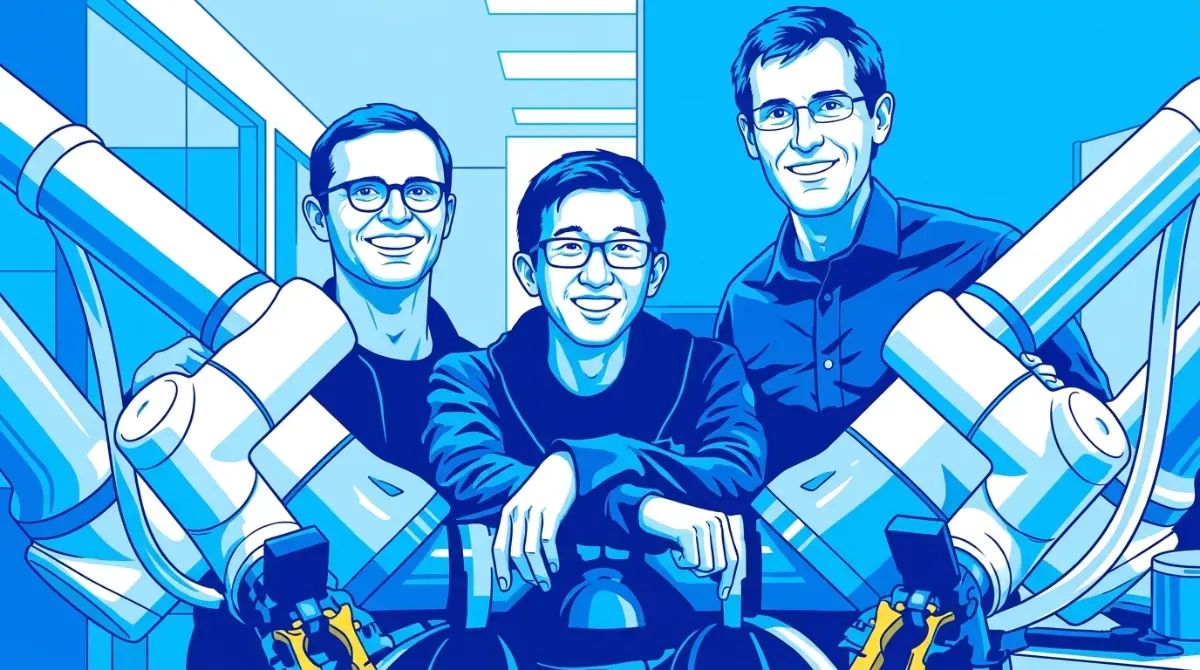


Sequoia Backs Mecka AI at $500M Valuation for Robot Data
The early-stage firm is collecting human motion records to teach machines how to interact with the physical world, sparking intense investor bidding wars.
Inioluwa Ademidun | 11 Sept. 2026 · 6 min read

I have watched venture capital shift its absolute focus over the last few financial quarters. The daily conversation among founders on Sand Hill Road has moved entirely away from generating text or synthetic images. The new obsession is physical movement. Building a mechanical arm is a solved engineering equation. Teaching that metal arm to fold laundry or assemble a motor requires an entirely different approach.
This exact blockage explains why Mecka AI is currently negotiating a fresh financing round led by Sequoia Capital. According to sources close to the discussions, the proposed deal places a $500M valuation on the two-year-old enterprise. This aggressive pricing arrives barely three months after the company secured a $60M check led by Framework Ventures. Other participants in that previous round included Menlo Ventures, SV Angel, and Kindred Ventures.
The sheer velocity of this capital injection tells a fascinating story about modern automation. We are watching top-tier investors rush to secure the foundational information that will eventually dictate how machines interact with our physical spaces.
Outsiders Solving an Insider Problem
When reviewing the early pitch decks circulating among investors, a clear pattern emerges. The most persuasive slide in their presentation did not feature complex neural networks. Instead, it highlighted the total addressable market of physical labor replacement. By framing human motion as a searchable commodity, the founders changed the conversation entirely. The team building this physical database did not spend their early careers in university robotics laboratories. Josh Gao, Mogen Cheng, Jason Chong, and Duy Nguyen focused their prior ventures on restaurant financial software and cryptocurrency applications.
This outsider perspective allowed them to identify a glaring gap in the market. Traditional engineers were entirely focused on hardware upgrades and algorithmic math. Meanwhile, the actual physical information required to train these systems was missing. An algorithm cannot learn to cook a meal or repair a bicycle by reading text documents on the internet. The founders realized that the industry needed thousands of hours of recorded human movement.
To solve this, the startup built a system to pay everyday people for their physical labor. Contract workers wear body sensors and use smartphone cameras to record themselves performing normal daily chores. They record themselves brewing coffee, fixing car parts, and cleaning rooms. The software captures these movements from a first-person perspective, translating human intuition into raw files that mechanical systems can process.
This method bypasses the slow and expensive process of teleoperation, where a researcher physically remote-controls a machine in a laboratory setting to teach it a specific task.
The Morality of Digitizing Human Labor
Covering this sector forces me to ask uncomfortable questions about the future of physical work. We are creating a temporary labor class paid specifically to train their eventual replacements. The individuals strapping sensors to their chests to record themselves folding shirts are providing the exact instructions a corporation needs to automate that job entirely.
This creates a heavy moral tension. We saw similar shifts when companies paid crowdsourced workers pennies to label images for early internet algorithms. Now, the demand has moved from the digital screen to the physical world. Whichever corporation controls the largest database of physical human movement will dictate the terms of the next industrial era.
Geopolitically, the race to build embodied intelligence is escalating rapidly. Nations that secure the best training records will manufacture the most capable automated factories. We are already witnessing trade restrictions blocking the export of advanced computer chips. It is only a matter of time before physical movement datasets are classified as protected national assets. The nation that controls the data controls the robotic workforce. Other organizations are already noticing this shift. We recently reviewed how capital is flowing into physical infrastructure, detailed in our coverage of how Andreessen Horowitz launched a dedicated machine age fund to support hardware founders.
Scaling Toward Nine Figures
Financial projections leaked during these funding talks suggest a highly aggressive growth path. In earlier interviews, the leadership team projected they would hit a $100M annual recurring revenue run rate by the end of 2026. Reaching that revenue mark within three years of incorporation would place the firm among the fastest-growing enterprises in recent history.
Managing the scaling phase presents massive hurdles. The company must verify the quality of thousands of hours of crowdsourced sensor records. A slight calibration error on a worker's smartphone could corrupt the entire movement file, rendering it useless for training a million-dollar machine. Early hires inside the engineering department are spending their days building automated filters to catch these errors before they reach the final database. During recent private cohort presentations, industry insiders noted that earlier attempts to build similar datasets failed entirely. Past companies relied on expensive laboratory environments equipped with million-dollar camera arrays. By embracing the messy, unpredictable nature of cheap consumer smartphones in real living rooms, this new approach captures the actual chaos of the physical world.
This financial momentum reflects the desperate need among hardware manufacturers to acquire usable physical information. Competitors like XDOF are also raising capital at massive premiums, with reports indicating they are seeking a $1.2B valuation. You can observe similar capital rushes across other specialized data markets, a trend we documented when Instinct AI secured its recent funding valuation.
Expanding the Data Supply Chain
Venture capital firms understand that the hardware layer of automation will eventually become commoditized. The real value lies in the proprietary information fed into those machines. If a startup can monopolize the physical records of how humans fix plumbing, cook food, or manage warehouse inventory, they hold immense pricing power over the hardware manufacturers.
The strategy deployed by Mecka mirrors the early days of Scale AI, which built a massive business by organizing digital text and images for language models. The physical world is infinitely more complex than a text document, requiring specific sensors, exact lighting conditions, and spatial mapping. The difficulty of capturing this information creates a massive barrier to entry for new competitors.
Institutional investors are clearly willing to pay a premium for companies that can solve this blockage today. We see this demand for specialized media searching in other sectors as well, matching the activity we reported when Clipto achieved its massive valuation jump.
As the ink dries on this Sequoia-led deal, the broader startup ecosystem is taking notes. The race to build the smartest algorithm is over. The new race focuses entirely on feeding those algorithms the best physical records of human life.
Read More on TechRobust:

Inioluwa Ademidun
 LinkedIn
Inioluwa Ademidun
Expertise:African Tech Ecosystem, Early-Stage Startups, Emerging Market Dynamics, Venture Capital & Tech Reporting, Product Management
Award:TechRobust Contributor of the Year 2025
Inioluwa is a Senior Product Manager by day and an investigative technology reporter by night, bridging the gap between scalable software architecture and high-impact journalism. She delivers deep-dive analysis on venture-backed founders, regulatory shifts, and grassroots tech ecosystems across Africa and global emerging markets.