
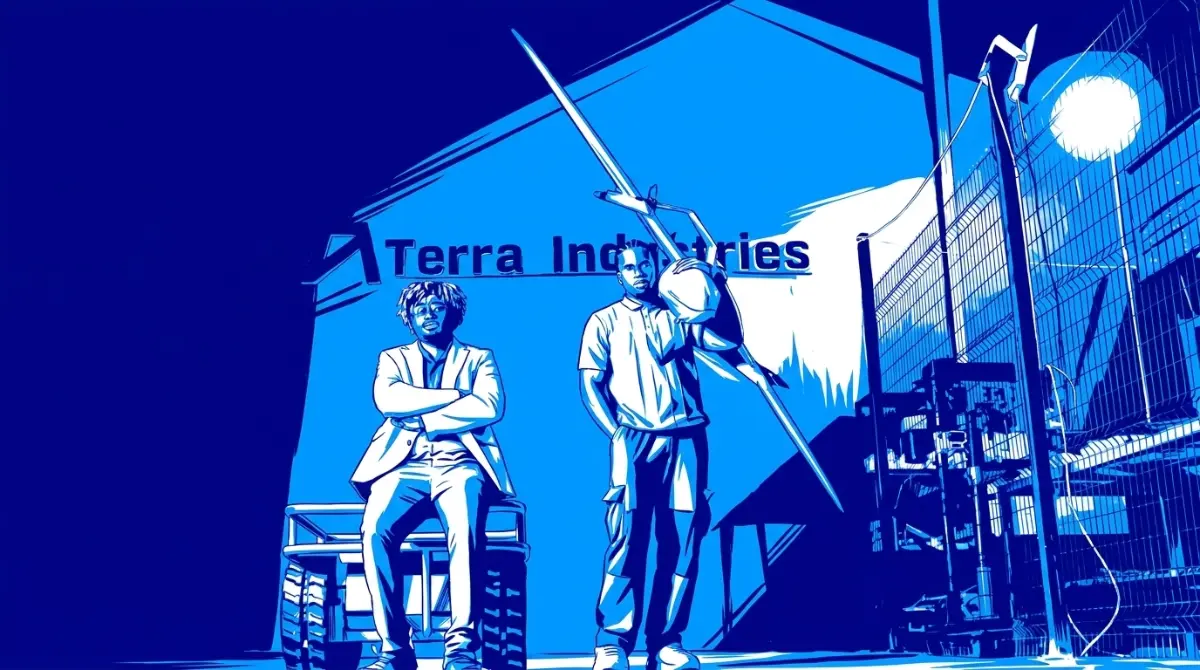


Terra Industries Faces Criticism Over Foreign Backing and Sovereignty
The Nigerian defense startup recently secured massive venture capital funding, but its close ties to American intelligence contractors are sparking intense national security debates.
Inioluwa Ademidun | 1 Sept. 2026 · 3 min read

Terra Industries launched out of stealth mode earlier this year with a massive financial round. The Nigerian defense organization secured an $11.75M seed investment led by 8VC. The company quickly accumulated more capital, raising an additional $22M in February and another $18M in August, bringing its total seed funding to $51.7M. The founders, Nathan Nwachuku and Maxwell Maduka, promoted the business as the first homegrown defense contractor in Africa. They built the company to help the continent manage its own security infrastructure without relying on outside powers.
Despite these early promises regarding local control, recent executive hires are generating heavy criticism. The organization recently appointed Todd Stiefler as the director of commercial expansion. Stiefler previously built go-to-market teams at Palantir, an American intelligence contractor. This appointment followed the addition of Alex Moore, a Palantir board member and 8VC partner, to the Terra board of directors. These moves are causing local journalists and national security watchers to question who actually controls the direction of the young organization.
The Foreign Intelligence Connection
The controversy centers entirely around the background of the investors. Joe Lonsdale co-founded both Palantir and 8VC. Palantir maintains active contracts with the United States Department of Defense, the Central Intelligence Agency, and the Israeli Ministry of Defense. Critics argue that allowing a firm with these specific connections to fund a Nigerian defense contractor creates a massive security risk. Journalists point out that giving foreign board members direct access to local security data completely contradicts the original mission of building independent African intelligence.
The debate over who controls restricted infrastructure data is a growing concern across the technology sector. Startups handling sensitive information are drawing intense scrutiny from regulators and the public alike. For context on how organizations manage these risks, you can review our coverage detailing how AIR secured $50M in seed funding to protect enterprise supply chains.
Commercial Expansion and Private Security
While the debate continues, Terra is aggressively expanding its operations. The business recently opened a new office in London, marking its first physical location outside of Africa. The newly formed commercial division will sell autonomous surveillance systems to private companies operating pipelines, power plants, mines, and shipping ports. The leadership team expects these systems to prevent billions of dollars in annual losses caused by physical sabotage and resource theft.
Nwachuku defended the foreign investments, stating that companies like Palantir prove defense contractors can successfully operate on a global scale. He emphasized that the commercial division will create a reliable cash flow through private partnerships, while military contracts remain the main focus of the business. The company stated it is on track to secure over $100M in contract bookings by the end of 2026. This fast growth matches the financial activity seen in other heavy industry sectors, similar to how Gridsight secured $26M in Series B funding to manage energy grids.
Balancing National Interests and Venture Capital
Building highly advanced military hardware requires massive financial resources that local banks rarely provide. African defense contractors often have to look overseas for the cash required to build autonomous drones and proprietary software like the ArtemisOS platform. But accepting money from firms tied directly to foreign intelligence agencies creates a very difficult situation for local governments relying on those products.
Supporters of the startup point out that the Nigerian military already buys physical hardware from foreign suppliers anyway. They argue that Terra is simply a private organization raising capital in a global market. But as the startup places its hardware around highly sensitive power plants and refineries across the Global South, the questions regarding foreign influence will only grow louder.
Read More on TechRobust:

Inioluwa Ademidun
 LinkedIn
Inioluwa Ademidun
Expertise:African Tech Ecosystem, Early-Stage Startups, Emerging Market Dynamics, Venture Capital & Tech Reporting, Product Management
Award:TechRobust Contributor of the Year 2025
Inioluwa is a Senior Product Manager by day and an investigative technology reporter by night, bridging the gap between scalable software architecture and high-impact journalism. She delivers deep-dive analysis on venture-backed founders, regulatory shifts, and grassroots tech ecosystems across Africa and global emerging markets.