
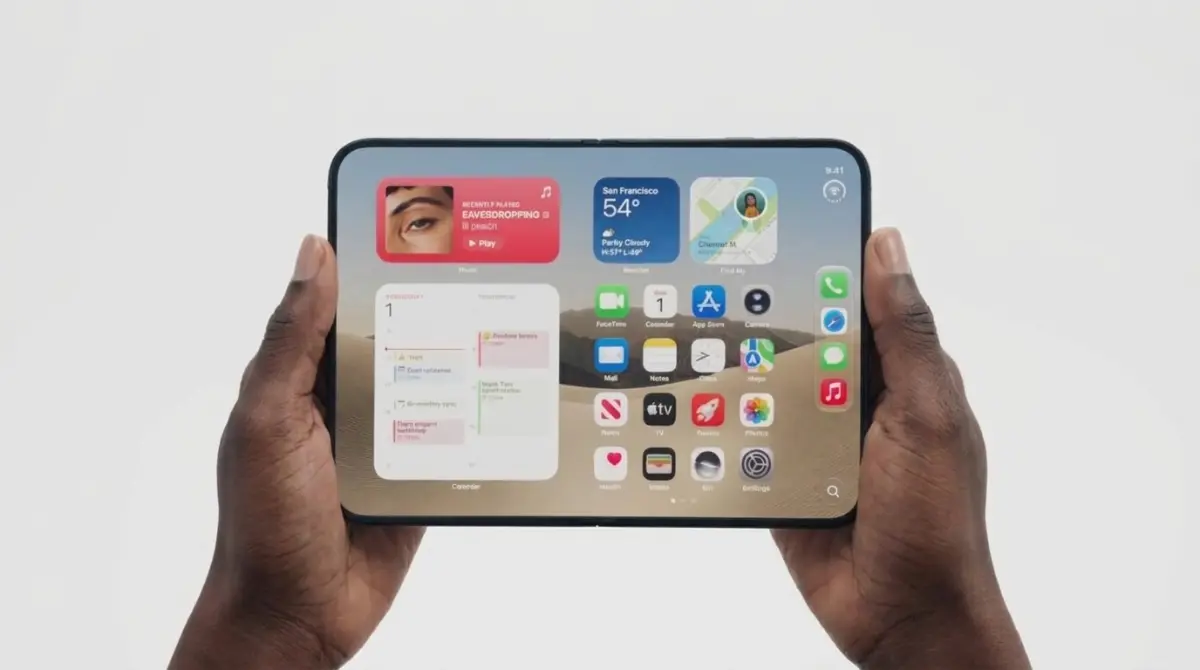


Apple Pays Samsung $250 Per Foldable iPhone Duo Screen
Samsung secures an exclusive three-year contract charging Apple $250 per foldable screen, capturing billions in revenue from Cupertino's $2,000 flagship smartphone debut.
Umar Abubakar | 11 Sept. 2026 · 7 min read

Sitting across from a veteran semiconductor analyst inside a bustling cafe near Taipei 101 six years ago, I listened as he sketched an intricate corporate food chain on the back of an envelope. He pointed at the famous California fruit emblem on my laptop, then circled the Korean industrial titan that supplies its silicon memory and glass panels. For decades, consumer marketing teams spent billions convincing casual shoppers that Cupertino and Suwon were engaged in a bitter, existential war for consumer affection. In retail stores and television ads, they mocked each other's hardware choices, fought over patent boundaries in federal courtrooms, and traded barbed press releases. Yet behind that theatrical curtain sat an unbending commercial truth: neither empire could survive without the other. Today, that symbiotic balance of power has delivered its most expensive invoice yet, handing Korean manufacturing lines an astonishing toll on every folding phone Apple sells.
Samsung Display has locked Apple into an exclusive three-year supply agreement to produce flexible glass panels for the newly introduced iPhone Duo, according to industry disclosures reported by AppleInsider. The terms of the arrangement require Cupertino to pay approximately $250 for each interior folding panel assembly. With retail pricing for the handset beginning at $1,999, the flexible display alone accounts for over twelve percent of the device’s gross shelf sticker, establishing the component as one of the priciest individual parts Apple has ever bought for a consumer device.
My career investigating corporate balance sheets and hardware supply corridors has shown me how masterfully Tim Cook spent fifteen years dominating suppliers, pitting competing vendors against each other to drive procurement costs down to the penny. Yet on the opening chapter of the foldable hardware era, newly appointed executive leadership faces a vendor with complete pricing leverage. Samsung stands as the solitary manufacturer capable of producing flexible panels that satisfy strict optical clarity, crease tolerance, and high-volume factory yield benchmarks. With no alternative suppliers ready to deliver at scale, Cupertino had to accept the $250 invoice or abandon its foldable ambitions altogether.
The Architecture of the $250 Panel
To grasp why a single phone component commands a $250 wholesale price, one must inspect the physical layers of the iPhone Duo screen. The interior 7.6-inch panel is not a standard flexible sheet; it marks the commercial debut of the M16 organic light-emitting diode material set. This chemical composition brings significant advances in peak luminance, color fidelity, operational lifespan, and electrical conservation compared to previous display generations.
The mechanical structure combines several distinct manufacturing steps. Rather than relying on a solitary thin glass substrate, the panel uses a dual ultra-thin glass structure assembled in coordination with industrial partner Dowoo Insys. Apple describes this as high-strength glass resting above and below the flexible emissive layer, providing structural rigidity against physical finger depressions while permitting a smooth bend along the mechanical spine. On the exterior surface, a specialized nano-texture finish disperses harsh ambient reflections, reducing visual awareness of the central folding seam.
Producing this multi-layer sandwich with near-zero microscopic defects demands unforgiving factory tolerances. Cleanroom yields on complex foldable displays historically struggle to reach sixty percent during initial production runs. When four out of every ten manufactured panels end up in scrap bins due to particulate contamination or micro-fractures, the surviving units must carry the financial burden of the entire fabrication run. That manufacturing reality explains why the bare display module carries an invoice higher than the complete bill of materials for many mid-tier Android smartphones.
Billions Flowing to an Arch Rival
The financial scale of this three-year arrangement is staggering. Wall Street projections from Citi forecast that Apple will ship approximately 7.3M iPhone Duo units during its initial twelve months of commercial release. Independent market analysts expect the device to secure twenty-five percent of the global foldable segment before year-end, moving roughly 5M units into distribution channels. At $250 per display panel, that shipment volume routes between $1.25B and $1.8B in high-margin component revenue straight to Samsung Display in year one alone.
This revenue transfer creates a fascinating corporate paradox. Samsung’s mobile division manufactures the Galaxy Z Fold8, a device competing for the exact same affluent consumer demographic in retail storefronts across North America, Europe, and Asia. When an undecided customer chooses an iPhone Duo over a Galaxy Fold, the Korean conglomerate does not walk away empty-handed; its display arm collects $250 on the sale. That incoming cash helps fund the conglomerate’s continuous silicon research, foundry expansions, and marketing initiatives, subsidizing the very organization competing against Apple in device aisles.
This dynamic illustrates how component divisions operate as sovereign profit islands inside Asian conglomerates. Samsung Display, while sharing corporate parentage with the mobile phone unit, functions as an independent profit center whose primary mandate is securing high-volume, long-term procurement checks from creditworthy global buyers. Winning an exclusive three-year commitment from Cupertino guarantees hundreds of millions in steady manufacturing cash flow regardless of which brand wins individual retail market battles.
The Monopolistic Supplier Dilemma
For Cupertino’s procurement command, signing a three-year single-source contract represents a reluctant retreat from established corporate practice. Apple typically avoids single-source dependencies, systematically cultivating secondary and tertiary vendors to spark price competitions. When sourcing flat OLED screens for traditional Pro handsets, the company splits orders among Samsung, LG Display, and China’s BOE, using order allocations to discipline component prices.
In foldable panels, that multi-vendor playbook does not exist. While LG Display produces experimental automotive displays and large-format panels, its mobile flexible production lines lack the high-yield capacity needed to support millions of iPhone shipments. Chinese display makers like BOE and Visionox have made strides supplying domestic phone brands, but ongoing patent disputes and technical yield inconsistencies keep them off Apple’s primary vendor roster for flagship hardware. Apple found itself with zero leverage: accept the Korean titan's price terms, or delay the foldable launch past 2026.
This vendor dynamic lands during an important leadership transition, arriving shortly after Apple appointed John Ternus as chief executive officer to direct the company’s post-Cook hardware era. Inheriting a corporate machine built on strict supply chain control, Ternus now oversees an inaugural folding device whose most vital physical component is owned, controlled, and priced by its primary marketplace competitor.
The Knock-On Shock of Repair Pricing
The steep $250 wholesale price tag carries sobering implications for consumers once units leave store shelves. When a component costs $250 at the factory gate before accounting for testing, shipping, custom chassis adhesives, and authorized technician bench labor, out-of-warranty replacement expenses escalate rapidly. Early repair estimates indicate that replacing a cracked or malfunctioning iPhone Duo interior display could cost consumers upwards of $1,000 at official service counters.
That astronomical replacement expense changes the economic calculus of hardware ownership. While a standard cracked glass backplate on a slab smartphone demands a manageable repair fee, an accidental screen puncture on a foldable device approaches half the cost of a brand-new handset. This financial reality will compel prospective buyers to purchase comprehensive warranty subscriptions, turning device protection plans into a required surcharge on top of the original $1,999 purchase price.
These repair complexities confirm the cautionary warnings raised by right-to-repair advocates, who pointed out how complex folding spines and glued flexible screens make independent servicing an economic impossibility. When hardware components are expensive and fragile, consumers lose the practical ability to maintain their own property, becoming dependent on authorized service channels.
Strategic Hardware Maneuvers Across the Industry
The financial scale of this display partnership reflects broader strategic shifts across the technology industry, where leading software and device platforms are forced to navigate massive supplier dependencies. We have tracked similar multi-billion-dollar infrastructure outlays across the computing sector, seen when Crusoe secured a $3B funding round at a $30B valuation for data centers to lock down physical capacity, and watched semiconductor alliances realign when Nvidia acquired MediaTek in a major semiconductor deal to consolidate hardware distribution channels.
Corporate platform developers are also restructuring commercial ties to defend operational boundaries, visible when CrowdStrike and OpenAI expanded their corporate partnership to secure agents across enterprise networks. Across every high-tech sector, from specialized cybersecurity software to high-density display fabrication, market leaders are discovering that independence is an illusion. True market power belongs to the entities that control the physical tools of production.
For Apple, paying $250 per display is the painful entrance fee required to enter the foldable device arena. If the iPhone Duo succeeds in drawing premium consumers away from Android alternatives, that steep component cost will be remembered as a calculated, worthwhile investment. But as long as that exclusive three-year contract remains in force, every customer who purchases an Apple foldable will be writing a generous check to the Korean competitor across the Pacific.
Read More on TechRobust:

Umar Abubakar
 LinkedIn
Umar Abubakar
Expertise:Editorial Leadership, Product Design (UI/UX), Digital Media Strategy, Technology Systems, Product Architecture
Award:TechRobust Visionary Leader of the Year 2025
Umar serves as Editor-In-Chief and CEO of TechRobust, combining editorial vision with senior product design expertise to shape how modern technology stories are built, packaged, and told. Overseeing all editorial verticals, he directs coverage across global and regional tech landscapes while applying deep design thinking to publication strategy and reader experience.