
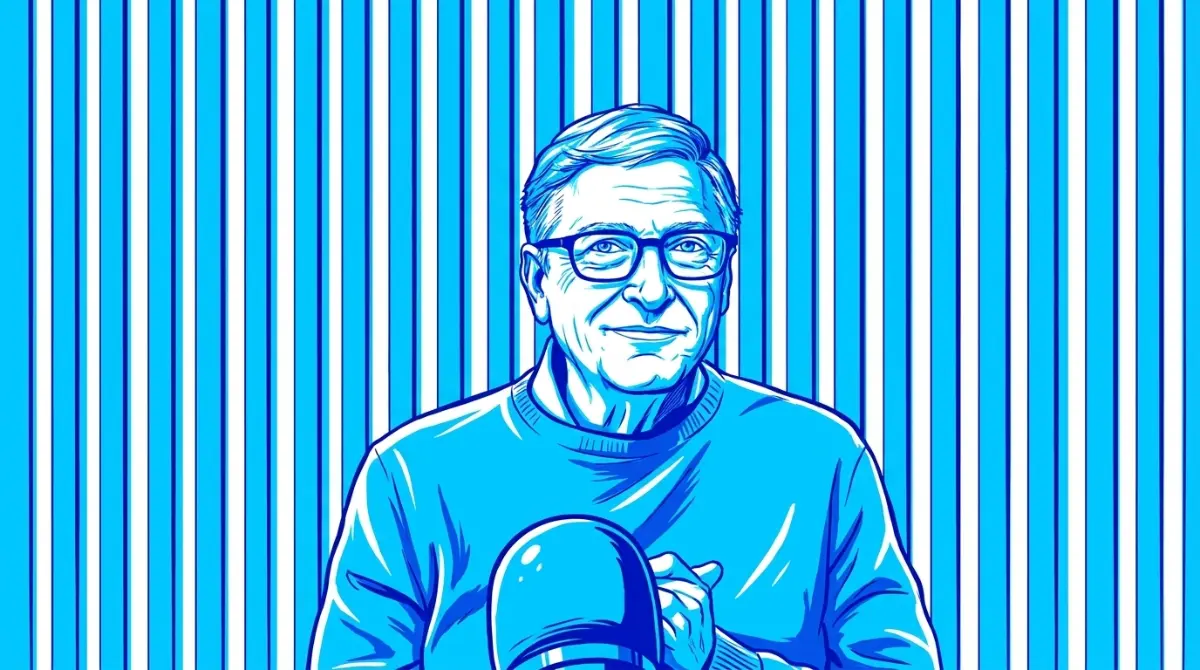


Bill Gates Warns of Severe Labor and Security Risks in New AI Essay
The Microsoft founder published a lengthy warning detailing how rapid machine learning adoption will permanently alter global employment, cybersecurity, and human relationships within ten years.
Umar Abubakar | 26 Aug. 2026 · 4 min read

Bill Gates just published a massive essay outlining his deep concerns regarding the rapid expansion of artificial intelligence. Writing on his personal GatesNotes website, the Microsoft co-founder warned that the shift toward a fully automated economy will cause intense global instability. He argued that political leaders and corporate executives currently lack an adequate plan to manage the coming changes across employment, education, and national security.
Speed of Adoption Breaks Historical Patterns
Many industry watchers compare the current technological wave to the arrival of the personal computer or the internet. Gates completely rejects this comparison. He noted that the personal computer took twenty years to alter office environments because companies had to buy expensive hardware, install new software, and train workers on complex interfaces.
Modern machine learning models bypass those hurdles completely. These new systems operate on smartphones that people already own and communicate using plain conversational language. Because the technology adapts to the user instantly, adoption happens overnight. Gates predicts this accelerated timeline will affect multiple industries at once, changing how law, medicine, customer service, and software development operate within a single decade.
Protecting Human Jobs and the Labor Market
Employment remains his biggest concern. He estimates that up to forty percent of current jobs face permanent replacement. Routine entry-level positions are the most vulnerable, meaning young adults might struggle to find their first jobs and build professional experience. While companies will save money on labor, the resulting unemployment could widen the gap between rich and poor.
To combat this, Gates introduced a concept he calls "Human Reserved" roles. He compares this idea to nature reserves, where society agrees not to build factories because the environmental cost is simply too high. He suggests applying the exact same logic to certain professions. Even if a robot can technically perform a task, society should agree that only a human should do it. He specifically highlighted child care, nursing, and jury duty as roles that require strict human emotion and empathy. Government action regarding artificial intelligence continues to expand globally, a trend we tracked closely when covering how judges supported government bans on certain AI applications.
Escalating Cyber and Biological Threats
Outside of the labor market, the essay highlights severe security risks. General-purpose models lower the technical barriers for launching cyberattacks. Hackers with limited coding experience can now use automated systems to locate software vulnerabilities and attack hospitals, electrical grids, and financial institutions.
The threat extends into biology. The exact same software that helps scientists discover new life-saving vaccines can also design deadly pathogens. Gates views engineered biological weapons as a much larger threat than naturally occurring pandemics because attackers can choose the exact location and time to release the virus. Monitoring how private companies handle these capabilities remains a constant issue, similar to the security adjustments we reported when OpenAI restricted model access following security concerns.
Psychological Effects on the Younger Generation
The social implications also worry the tech billionaire. As companies release automated companions that never get angry and always agree with the user, young people might stop interacting with real humans. Real relationships require patience and conflict resolution. If teenagers replace their friends with agreeable software programs, they could lose the ability to socialize properly in the real world.
He also noted that students relying heavily on automated text generators to finish their homework might miss out on productive struggle. Learning happens when a student fights through a difficult math problem or writing assignment. Having a machine spit out the final answer stops the actual learning process entirely.
Calling for Immediate Government Action
Ultimately, Gates believes current regulatory frameworks are entirely inadequate. He stated that the government response to artificial intelligence must exceed the massive institutional changes made after the September 11 terrorist attacks. Because automated systems affect tax codes, elections, public health, and law enforcement simultaneously, creating a single new regulatory agency will not work. Entire governments must restructure how they operate to handle the coming shifts in economic and social power.
While he still sees the massive medical and scientific benefits these systems can provide, his tone is noticeably more pessimistic than in previous years. He ended the essay by urging leaders to act immediately before the technology outpaces their ability to govern it.
Read More on TechRobust:
Umar Abubakar
 LinkedIn
Umar Abubakar
Expertise:Editorial Leadership, Product Design (UI/UX), Digital Media Strategy, Technology Systems, Product Architecture
Award:TechRobust Visionary Leader of the Year 2025
Umar serves as Editor-In-Chief and CEO of TechRobust, combining editorial vision with senior product design expertise to shape how modern technology stories are built, packaged, and told. Overseeing all editorial verticals, he directs coverage across global and regional tech landscapes while applying deep design thinking to publication strategy and reader experience.