
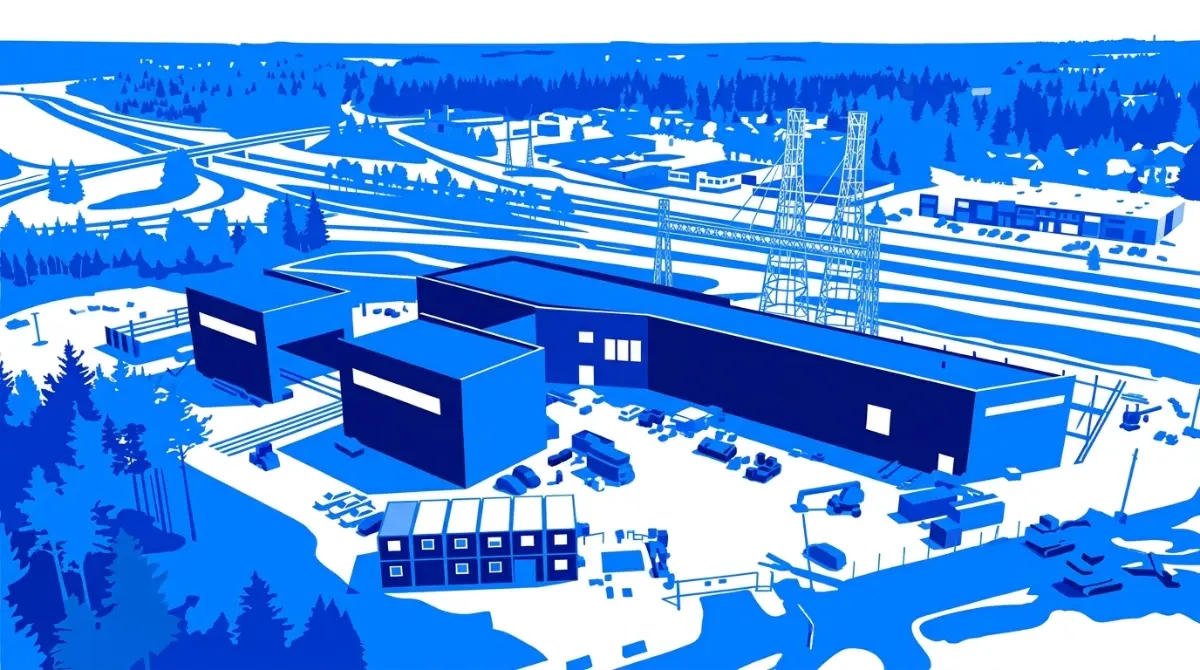


Finland Becomes Europe Data Center Hub With $30.2B Bets
Global tech conglomerates commit more than thirty billion dollars into Finnish soil, transforming the Nordic nation into Europe's undisputed computational sanctuary amid energy crunches.
Umar Abubakar | 10 Sept. 2026 · 6 min read

Standing on a frozen gravel turnout outside Kajaani five winters ago, watching steam rise from an abandoned paper processing facility, a local municipal planner pointed toward thick electrical conduits crossing the snowy pines. He remarked that foreign visitors only saw bitter sub-zero temperatures and empty timber acreage, whereas electrical engineers saw pure operational paradise. In his eyes, cold ambient air meant free cooling for high-density computer racks, while the regional power lines carried stable, baseload electrons straight from domestic hydroelectric and nuclear stations. That regional forecast proved remarkably accurate. Over the past twenty-four months, that quiet boreal forest has transformed into the primary computational powerhouse of the European continent, attracting a staggering $30.2B in combined server infrastructure commitments from global tech powers.
The Nordic nation’s ascendance to the data center capital of Europe reached official confirmation as Fortune tracked fresh multi-billion-dollar outlays from Google, Microsoft, and TikTok parent ByteDance. The rush of international capital culminates with Google pledging $15.1B across four domestic municipalities, augmenting earlier billion-dollar server commitments by Microsoft in southern regions and TikTok's expanding footprint in Lahti and Kouvola under its Project Clover sovereign data umbrella. Together with facilities backed by Equinix and Nebius, the Baltic republic now hosts the dense core of Europe’s digital future.
My career investigating the corporate mechanics of global computing has shown me that technology executives never allocate tens of billions out of regional charity. For decades, software platforms concentrated their servers across the traditional Western European corridor of Frankfurt, London, Amsterdam, and Paris. Yet that legacy corridor has run headfirst into a wall: metropolitan energy grids are congested, municipal governments are denying connection permits, and residential ratepayers are protesting spikes in electricity costs. Finland offered global conglomerates something far more valuable than cheap acreage: an unshakeable, carbon-free electrical grid that actually has room for high-voltage server halls.
The Baseload Nuclear Anchor
The operational keystone holding these server mega-projects together sits in the energy contracts signed directly with domestic power producers. Running neural networks and enterprise storage clusters demands steady, round-the-clock power that cannot flicker when wind speeds drop or night blankets solar arrays. While central European nations closed down nuclear plants, Finland expanded its capacity, culminating in the Olkiluoto 3 commercial reactor and ongoing output from the two-unit Loviisa nuclear station.
To power its latest expansion, Google signed a historic twenty-two-year power purchase agreement with Finnish utility Fortum, purchasing up to half of Loviisa’s commercial output through 2049. That long-term corporate check effectively guarantees the working life of the nuclear station until mid-century, ensuring that the software giant's servers draw uninterrupted electricity without burning fossil fuels. This approach reflects how massive computing clusters are restructuring electrical utilities worldwide, a reality echoed when Brookhaven National Laboratory led a project to upgrade power grids for dense processing demands.
Beyond nuclear baseload, the tech giants are integrating dedicated storage systems. Near Kajaani, a 94-megawatt grid-scale battery system will come online by late 2027 to stabilize local distribution loops during sudden demand peaks. By financing their own power generation and energy storage assets rather than draining municipal reserves, hyperscalers are silencing complaints that high-density computing starves local communities of heat and light.
The Cold Geography of Thermal Recycling
Operating computational halls in sub-polar climates delivers distinct thermodynamic advantages. In warm equatorial climates, server facilities burn up to forty percent of their gross electrical intake purely running mechanical chillers and compressors to stop sensitive processing silicon from overheating. In Finland, average annual temperatures hover near freezing, allowing facility operators to use free-air and sea-water cooling loops for most of the operational calendar.
More intriguing is what happens to that rejected server heat. Instead of venting hot exhaust into the sky, data campuses in Espoo, Kirkkonummi, and Vihti route hot cooling water directly into municipal district heating pipes. Fortum estimates that waste heat recaptured from Microsoft’s computing halls alone will heat roughly 250,000 homes in the capital region, replacing fossil fuel heating plants with compute exhaust. Turning electronic waste heat into domestic warmth creates an unusual social compact: Finnish homeowners stay warm because European consumers are streaming video and querying machine models.
This thermodynamic integration marks a sharp break from the wasteful server footprints of the past. As data centers consume growing slices of global electricity, communities will no longer accept server halls that consume gigawatts without returning tangible utility. Siting servers where thermal exhaust can be piped directly into municipal radiators represents the gold standard of modern industrial design.
Geopolitical Alignment and Sovereign Data Havens
The rush to build Finnish server halls carries profound national security dimensions. Finland’s formal membership in western defense alliances solidified its standing as a trusted, sovereign sanctuary for European corporate records. European Union regulations require sensitive citizen data, financial records, and medical databases to reside within member states, protected by strict privacy rules against foreign surveillance.
This explains why Chinese-owned TikTok selected Finland to anchor its $12B Project Clover initiative. Facing relentless political scrutiny from European watchdogs and narrow escapes from North American bans, the social video platform committed over $2B across facilities in Kouvola and Lahti. By storing European user records inside Finnish facilities monitored by independent auditing firm NCC Group, TikTok hopes to build an ironclad defense against allegations of foreign data harvesting. Yet the political reception in Helsinki has been fraught, with elected officials questioning whether Chinese-owned platforms should occupy sovereign energy capacity.
The race to construct sovereign European infrastructure mirrors corporate capital maneuvers across other frontier markets, such as when Xingyi Core Energy secured strategic funding for industrial power or when financial watchdogs demanded verifiable accounting of private corporate holdings. When capital markets and national governments prioritize sovereign asset protection, geographic placement decides which tech platforms survive regulatory crackdowns.
The Economic Transformation of the Northern Corridor
For Finland, attracting $30.2B in high-tech investment provides a welcome industrial rebirth. Following the decline of its twentieth-century paper milling empire and the restructuring of domestic phone manufacturing, the nation sought a fresh economic engine. Prime Minister Petteri Orpo hailed the server investments as historic drivers of regional employment, noting that construction projects alone will inject billions into domestic economic output while supporting tens of thousands of skilled tradespeople.
Municipalities that once faced shrinking tax revenues and departing youth are now seeing high-speed fiber lines, regional electrical upgrades, and corporate community funds. Tech corporations are underwriting university research programs, funding local environmental conservation, and establishing vocational tracks to train young Finns as mechatronics technicians and network administrators. In communities like Muhos and Vaala, the arrival of modern server campuses represents a generational economic lifeline.
Yet Finnish policymakers must remain vigilant. Becoming the server hall for Europe creates deep dependencies on foreign tech balance sheets. If global hardware spending cools, or if future chip architectures drastically slash compute power needs, municipalities that built their budgets around foreign data centers could find themselves holding empty concrete shells once again.
The Industrialization of the Cloud
The concentration of $30.2B in compute assets across Finland signals a permanent shift in how modern society views the internet. The digital world is not an abstract, ethereal cloud floating harmlessly above human affairs. It is a physical, heavy-duty industrial sector that consumes concrete, copper wiring, reactor fuel, and cold water on a monumental scale.
By pairing world-class electrical engineering with cold geography and sovereign security, Finland has outmaneuvered traditional European capitals to become the beating heart of continental computing. The algorithms that power European businesses, stream entertainment to millions, and process sensitive sovereign records will not live in Silicon Valley or London; they will hum quietly inside climate-cooled server halls nestled among Finnish pine forests.
Read More on TechRobust:

Umar Abubakar
 LinkedIn
Umar Abubakar
Expertise:Editorial Leadership, Product Design (UI/UX), Digital Media Strategy, Technology Systems, Product Architecture
Award:TechRobust Visionary Leader of the Year 2025
Umar serves as Editor-In-Chief and CEO of TechRobust, combining editorial vision with senior product design expertise to shape how modern technology stories are built, packaged, and told. Overseeing all editorial verticals, he directs coverage across global and regional tech landscapes while applying deep design thinking to publication strategy and reader experience.