
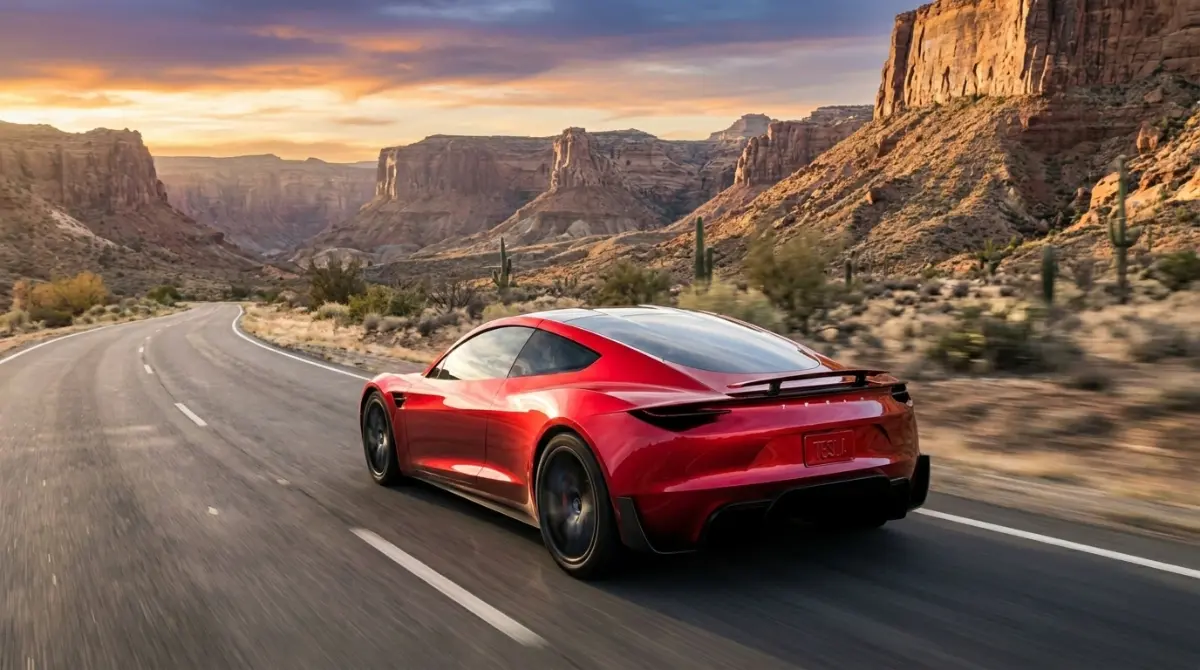


Tesla Sets October 1 Date for Second Generation Roadster
Nine years after revealing its original sports car concept, the automaker scheduled an autumn presentation promising rocket hardware, while production remains distant.
Umar Thariwat | 13 Sept. 2026 · 5 min read

Standing in the Hawthorne airplane hangar in November 2017, I watched Elon Musk lower the ramp of an electric semi-truck to roll out a gleaming cherry-red sports car prototype. The promises flowed effortlessly that night. We were told the second-generation vehicle would reach sixty miles per hour in under two seconds, pack a six-hundred-mile battery pack, and reach customer garages by 2020. Six years past that original deadline, the vehicle had become the automotive world's most famous piece of vaporware. When the manufacturer posted a sudden teaser graphic stamped with the words "Go for launch" and the date October 1, the collective industry paused to assess whether this event represents genuine engineering completion or an elaborate corporate distraction.
The timing of this announcement deserves rigorous skepticism. Over the past few weeks, corporate leadership has faced a string of difficult headlines. Regulatory authorities opened inquiries into driverless passenger pods in Texas, consumer demand for older electric sedans softened across major markets, and margin pressures forced deep spending cuts. Dropping a dramatic hypercar invitation allows the brand to redirect public conversation away from regulatory scrutiny and back toward high-octane spectacle. You can review how transportation regulators are examining recent passenger fleet deployments by reading our investigation into how federal regulators probe Tesla Cybercab deployment over safety rules.
The Long Wait for Reservation Backers
Behind the glossy social media announcements sits an awkward financial reality for the early believers who funded the project. Following that 2017 stage reveal, the company collected substantial cash deposits from passionate consumers. Regular buyers transferred $50,000 to hold a reservation queue spot, while Founders Series patrons wired $250,000 in full upfront cash to secure early delivery chassis numbers. That interest-free capital pool provided non-dilutive liquidity when the automaker was struggling through factory manufacturing bottlenecks for mass-market sedans.
As the delays mounted, patience among those high-profile backers wore thin. Last year, the vehicle became the focus of public friction between corporate executives. Sam Altman, the chief executive officer of OpenAI who put down fifty thousand dollars for an allocation, openly complained that waiting over seven years felt excessive. Musk shot back that the deposit was returned, but the public clash exposed the growing frustration surrounding the stalled production timeline. Holding onto customer deposits while repeatedly shifting delivery schedules tests brand loyalty, a dynamic we monitored when examining how Tesla rolls out commercial Cybercab robotaxi rides during public testing.
SpaceX Rocket Hardware and Design Overhauls
The vehicle taking the stage on October 1 will look entirely different from the red prototype unveiled almost a decade ago. Investigative reporting revealed that the engineering division abandoned the 2017 design framework after realizing that battery weight penalties made original performance metrics impossible to hit with standard road suspension. The updated exterior sports sharper body angles, aggressive active downforce channels, and reworked carbon fiber panels intended to house specialized cold gas thrusters developed in conjunction with SpaceX.
The aerospace crossover is central to the planned autumn presentation. Promotional graphics echo orbital rocket launches, hinting at an ambitious live demonstration where high-pressure gas nozzles attempt to lift the chassis off the pavement or assist cornering agility. While demonstrating a vehicle equipped with rocket nozzles makes for sensational internet video clips, the real-world utility of installing compressed air tanks in a consumer automobile remains doubtful. Commercial regulators and pedestrian safety boards rarely permit street-legal cars to blast high-velocity air streams across city sidewalks. Staging an elaborate technical display using aerospace hardware serves another corporate objective: warming institutional investors to the possibility of closer corporate integration between the automotive entity and the private rocket manufacturer.
Production Realities and Manufacturing Hurdles
Beyond the theatrical stage presentation, the fundamental manufacturing equation has not changed. Musk admitted during investor interactions that assembly lines will not begin serial production for another twelve to eighteen months following the autumn event. That puts actual customer deliveries deep into late 2027 or 2028, assuming the company encounters zero tooling holdouts or supply chain disruptions.
Building a low-volume hypercar requires specialized tooling that cannot be shared with mass-market vehicles. Factory lines in Texas and California are currently optimized for stamping steel body panels and packing lithium cells for consumer trucks and crossovers. Shifting factory floor capacity, human engineering talent, and capital reserves toward a niche sports car conflicts directly with the corporate goal of producing millions of affordable vehicles. Enterprise operators often find that managing complex physical hardware programs strains executive resources, an operational lesson highlighted when we reported on how Xingyi Core Energy secured strategic funding for industrial scale.
The Public Market Reaction
Wall Street will review the October presentation through a strict financial lens. Institutional portfolio managers understand that a high-priced hypercar will not alter quarterly earnings sheets or solve competitive price wars in Asian markets. The real value of the Roadster lies in brand equity and halo marketing, reminding consumers that the enterprise can construct aspirational machines that outrun European supercars.
Yet as macroeconomic conditions tighten and buyers scrutinize discretionary spending, the novelty of million-dollar acceleration tricks begins to fade. If the presentation fails to deliver firm pricing, audited performance figures, and a legally binding production date, market skeptics will view the launch as another unfulfilled promise. For the early reservation holders who signed checks nearly ten years ago, October 1 will reveal whether their patience is finally rewarded or if the finish line has simply moved again.
Read More on TechRobust:

Umar Thariwat
 LinkedIn
Umar Thariwat
Expertise:Tech News Reporting, Tech Business Analysis, Economic Foundations, Market Trends, Digital Economy
Award:Rising Voice of the Year 2025
Thariwat is a Staff Writer and Reporter covering tech news and enterprise trends at TechRobust. Blending daily reporting with her ongoing academic background in economics, she analyzes earnings, digital market, and the commercial strategies powering the global tech sector.