
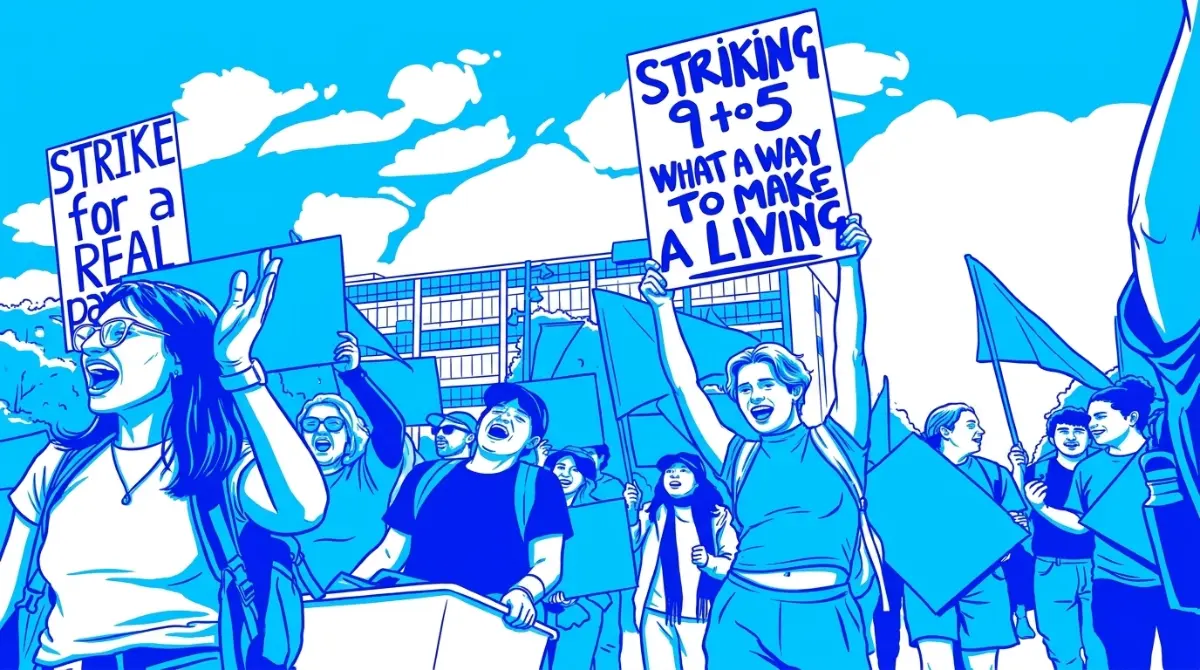


University of Sydney Staff Strike Over Artificial Intelligence and Job Security
Thousands of employees at the University of Sydney staged a massive walkout to protest management decisions regarding artificial intelligence implementation and long term employment guarantees.
Umar Abubakar | 2 Sept. 2026 · 3 min read

About 2,000 employees at the University of Sydney recently walked off the job to protest how the institution handles artificial intelligence and employment stability [1]. The strike, organized by the National Tertiary Education Union, forced the administration to move almost all scheduled classes online or cancel them entirely [1]. The protest highlights growing tensions between educational workers and management over the rapid introduction of automated software into the classroom [1].
The main disagreement centers on how the university plans to regulate these new digital tools [1]. Union representatives want clear protections written directly into their enterprise agreements to prevent software from replacing human workers [1]. Management prefers to handle these issues through flexible internal policies rather than binding labor contracts [1].
Eroding Trust Between Staff and Management
The relationship between the administration and the teaching staff appears severely damaged [1]. Just days before the 24 hour strike began, the university released the results of an internal survey [1]. The data showed that absolutely zero percent of respondents within the faculty of arts and social sciences trusted the administration to act in the best interests of employees or students [1].
Peter Chen, the local union branch president, stated that management repeatedly refused to negotiate appropriate guidelines for the technology [1]. He warned that higher education serves as an early indicator for the rest of the economy [1]. If universities successfully replace educators with chatbots, other industries will likely follow the exact same path [1].
Concerns about automation replacing human workers extend far beyond the education sector. Similar debates over labor rights and corporate policy continue to affect major organizations globally, a pattern seen when Uber shut down its operations in Nigeria and Uganda during a global restructuring effort.
The Push for Clear Guardrails
The protesters are not asking for a complete ban on the technology [1]. Vince Caughley, the state division secretary for the union, explained that workers want the university to implement strict due diligence [1]. The union fears the administration is prioritizing commercial goals over educational quality [1]. They worry that external financial pressures will push the university to rely heavily on automated systems to cut costs [1].
Kurt Iveson, a geography professor who joined the picket line, mentioned that the technology should serve the educational process, rather than forcing educators to adapt to the software [1]. He emphasized that the staff walked out precisely because they care deeply about research and teaching standards [1].
Other institutions are already testing the limits of these automated tools. For context on how competing schools approach this issue, The Guardian reported that Macquarie University recently deployed an automated chatbot to help instruct online psychology classes.
University Management Defends Its Approach
A spokesperson for the university described the strike as premature [1]. The administration insists it remains committed to a human centered approach when deploying these new systems [1]. Management claims they developed their current guidelines after consulting with the campus community [1].
The administration agrees with many of the union goals but completely disagrees on how to implement them [1]. By keeping the rules in policy documents rather than the formal enterprise agreement, the university retains the power to change the rules quickly without renegotiating with the union [1].
The debate over who controls the introduction of advanced computing tools is creating friction across multiple sectors. You can track how business leaders handle these transitions by reading our coverage of how Nvidia leadership questions general machine intelligence milestones.
As the standoff continues, both sides refuse to back down [1]. The outcome of this dispute could set a legal precedent for how workplaces across the country integrate automated software while protecting their human workforce [1].
Read More on TechRobust:

Umar Abubakar
 LinkedIn
Umar Abubakar
Expertise:Editorial Leadership, Product Design (UI/UX), Digital Media Strategy, Technology Systems, Product Architecture
Award:TechRobust Visionary Leader of the Year 2025
Umar serves as Editor-In-Chief and CEO of TechRobust, combining editorial vision with senior product design expertise to shape how modern technology stories are built, packaged, and told. Overseeing all editorial verticals, he directs coverage across global and regional tech landscapes while applying deep design thinking to publication strategy and reader experience.